

Wholesale RCCB Guide How to Choose the Best Residual Current Circuit Breaker for Your Projects
2026-10-18
Selecting the right Residual Current Circuit Breaker (RCCB) for a wholesale project isn't just about matching amperage—it's about anticipating real-world fault conditions that can shut down an entire installation. Too many buyers default to the cheapest option, only to face nuisance tripping or, worse, inadequate protection. This guide cuts through the noise, walking you through the critical specs—from sensitivity ratings to breaking capacity—and shows why ETEK has become a trusted name for contractors who need reliable, compliant RCCBs at wholesale volumes.
What Your Project's Residual Current Profile Actually Looks Like
Real-world residual current rarely resembles the clean sine wave you see in textbooks. Instead, it tends to carry a messy mixture of 50/60 Hz fundamental, odd harmonics from switched-mode power supplies, and short-duration spikes whenever motors or solenoids cycle. On a scope, this shows up as a baseline that wanders by a few milliamps, punctuated by irregular bursts that align with equipment start-stop events.
In many projects, the dominant feature isn't a steady leakage but a repeating pattern of transient pulses. These pulses often have rise times in the microsecond range and decay within a few milliseconds, driven by parasitic capacitance in long cable runs or by the rapid switching of IGBTs in variable frequency drives. The result is a profile that looks more like a comb of narrow spikes riding on a slowly shifting DC offset than a predictable AC waveform.
What surprises most engineers is how much the profile changes with seemingly minor operational details. Adding a single nonlinear load can introduce new harmonic content, while changes in humidity or cable insulation aging shift the baseline leakage upward. Instead of a static signature, the residual current profile behaves like a live fingerprint—constantly reacting to the load mix, grounding conditions, and even the time of day.
RCCB Classes Without the Usual Confusion
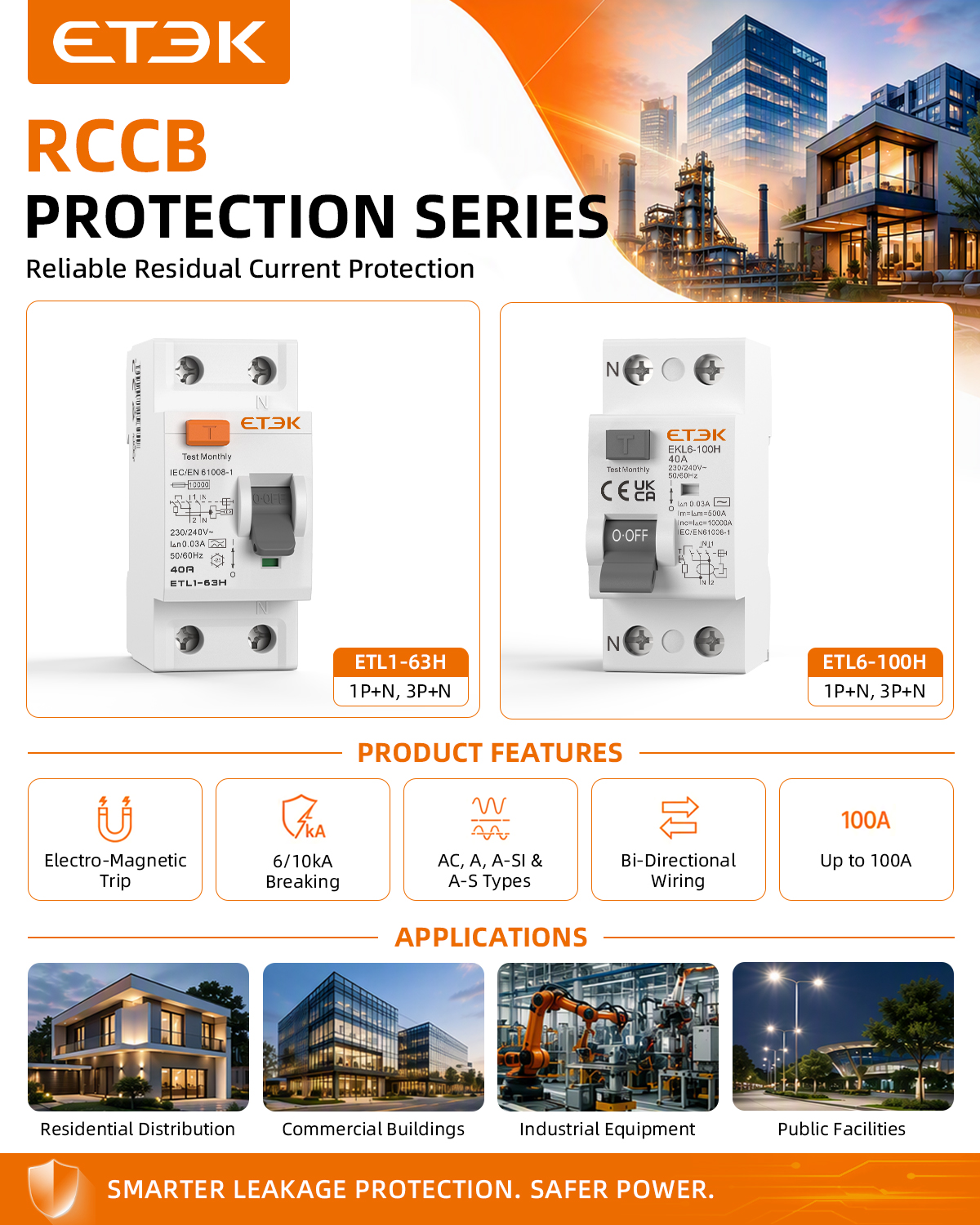
Ask an electrician about RCCB classes and you’ll likely get a pause, then a list of letters that somehow still leaves you uncertain. The labels AC, A, F and B are not grades or quality levels. They describe which fault current shapes the device can actually recognize. Once you treat them as a language for residual current, the whole thing stops being abstract.
Class AC is the old workhorse: it responds to pure sinusoidal AC leakage, the kind produced by simple resistive loads like heaters or incandescent lighting. Most modern installations, however, are full of rectifiers and variable speed drives that generate pulsating DC or mixed frequency leakage. That’s where Class A takes over, adding detection for pulsating DC components. Class F builds on A and is designed for circuits with single-phase frequency converters, such as washing machines and heat pumps, handling higher frequency residual currents without nuisance tripping. Class B goes further still, covering smooth DC and high-frequency AC, which matters for EV chargers, PV systems and industrial drives.
A practical rule: match the class to the loads, not to the price. Installing a Class AC device downstream of an inverter or charger can create a false sense of safety because it may sit silent during a fault it cannot see. If you have three-phase rectifiers, battery storage or direct current sources, specify Class B from the start. Otherwise, the letters become less of a mystery and more of a straightforward selection tool.
Breaking Capacity and Voltage Ratings That Won't Let You Down
A breaker's breaking capacity is often the last number checked on a datasheet, yet it's the first thing that matters when a dead short occurs. Most panels are conservatively rated, but real-world fault currents can spike beyond the utility's stated maximum—especially in older buildings with long feeder runs or multiple motor loads. A device rated for 10 kA will weld its contacts or fail catastrophically under a 22 kA fault, whereas a 25 kA-rated unit simply opens and resets. The margin isn't just safety; it's uptime.
Voltage ratings follow a different logic. A 240V breaker used on a 480V system doesn't just trip early—it arcs internally and can create a phase-to-phase fault. The dielectric strength of the housing, the contact separation speed, and the arc chute design all depend on the rated voltage class. For DC circuits, the problem doubles: breaking a DC arc requires much longer contact travel, so a breaker rated for 250V AC might only handle 48V DC reliably.
When specifying, don't rely on nameplate numbers alone. Ask for a copy of the actual type test report—the one where the manufacturer shorted the device at full rated voltage and recorded the let-through energy. If the report shows a test at 80% of rated breaking capacity, walk away. Field failures from under-rated components are expensive, and the replacement cost is trivial compared to a day of unplanned downtime.
Sensitivity Settings That Reduce Nuisance Trips
Most nuisance trips trace back to settings that are either too eager or too broad. Instead of cranking sensitivity to maximum, start by narrowing the trigger zone. If the sensor supports masking or beam blanking, disable unused channels so passing reflections, dust, or nearby machinery don't count as targets. A lower gain paired with a longer confirmation time often filters out transient spikes while still catching real intrusions.
Timing matters as much as threshold. Look for a dwell time or debounce option and raise it slightly—this tells the system to ignore events that don't persist for a minimum duration. In motion detection, for instance, a 200–300 ms delay rejects brief shadows and flying insects while keeping response fast enough for human movement. Avoid setting this too high, or you'll trade nuisance trips for missed alarms.
Finally, test changes under real conditions, not just static calibration. Walk the perimeter at different speeds, introduce normal environmental disturbances like HVAC airflow or passing forklifts, and watch for false triggers. Adjust sensitivity downward only until the correct target still produces a reliable trip with at least two consecutive detections. This iterative approach keeps the system honest without leaving gaps.
Panel Space, Busbar Fit, and Other Overlooked Details
When you're deep into a panel layout, it's easy to fixate on breaker counts and leave room for the busbar as an afterthought. But tight vertical space around the main lugs can force awkward bends on feeder cables, and a busbar that doesn't line up with your knockout pattern will eat hours on site. I've seen panels where the factory busbar sits just a few millimeters off the enclosure's intended entry point, turning a simple termination into a fight with offsets and reducing washers.
Another often-missed dimension is the gutter space on either side of the breaker mounting rail. You might have the depth for the device, but if the side gutters are too shallow, the wire bundling gets compressed against the dead front. This is especially true on retrofit jobs where old panels had narrower channels and the new interior parts are wider even though the enclosure footprint is the same. Checking the actual bend radius of your largest conductors against the available gutter width before mounting anything prevents a lot of frustrated rework.
Don't overlook the small metal details either: the placement of ground bar screws, the clearance for a surge protector module near the neutral assembly, and whether the panel's hinge pins will interfere with a flush-mount trim. These aren't exciting specs, but they show up as scraped knuckles and misaligned covers. A few minutes with a tape measure and the real component in hand beats trusting a dimension sheet that was drawn two revisions ago.
Certification Marks and Wholesale Supply You Can Rely On
A certification mark only matters if it is backed by a supply chain that refuses to cut corners. We treat every batch as an extension of our own reputation, which means documentation is checked before products move, not after a problem surfaces. That habit removes guesswork and makes compliance a daily routine rather than an audit scramble.
Reliability in wholesale comes down to boring but essential things: accurate stock counts, honest lead times, and packaging that arrives the way it left the warehouse. Our team monitors each stage with a simple rule of thumb—if we would not accept the shipment ourselves, it does not leave the dock. This keeps surprises rare and trust intact.
For buyers, that translates into fewer follow-up calls and more time spent growing their own business. The marks on the label are not decorative; they reflect a chain of custody that can be traced, questioned, and verified. That is what makes a wholesale partnership feel less like a transaction and more like a dependable back office.
FAQ
An RCCB, or Residual Current Circuit Breaker, monitors the balance between live and neutral currents. It trips when it detects a leakage current to earth, typically 30mA or less, which can indicate someone touching a live part or faulty insulation. Unlike a standard breaker that only protects against overload and short circuits, an RCCB is specifically designed to prevent electric shocks and reduce fire risks from earth faults.
Wholesale purchasing makes sense for larger installations or ongoing projects because it lowers the per-unit cost significantly, ensures consistent availability across multiple sites, and lets you keep a backup stock for quick replacements. It also simplifies logistics when you're dealing with dozens of distribution boards rather than a single household unit.
Focus on the rated current (often 25A, 40A, 63A, or higher), the residual operating current (30mA for personal protection, 100mA or 300mA for fire prevention only), the number of poles (2-pole for single-phase, 4-pole for three-phase), and the breaking capacity. Also verify the type: AC for resistive loads, A for circuits with electronics, or B for systems with DC leakage like EV chargers.
For residential circuits where people directly touch appliances, 30mA is standard. In commercial or industrial settings, you might use 100mA or 300mA on main distribution boards to avoid nuisance tripping while still providing fire protection, then install 30mA units on final subcircuits feeding sockets or wet areas. The key is matching sensitivity to the level of human contact risk and the nature of connected equipment.
A frequent error is mixing up RCCBs with RCBOs (which combine overload and leakage protection) and then under-sizing the overload protection. Another is failing to account for cumulative leakage currents from many devices on the same circuit, leading to unwanted tripping. Also, some installers forget to test the RCCB with its test button after wiring, or they use the wrong type (e.g., type AC on a circuit with variable speed drives).
Type AC RCCBs only detect sinusoidal AC leakage currents, which is fine for simple resistive loads like heaters or incandescent lights. Type A units also respond to pulsating DC components, which are common with modern electronics, washing machines, induction hobs, and LED drivers. If your project includes any switch-mode power supplies or even basic household appliances with electronic controls, you need Type A or higher to avoid false negatives where a genuine fault goes undetected.
Multiple smaller RCCBs on branch circuits are almost always better. A single large RCCB on the main panel means a minor earth fault in one area kills power to the entire facility, creating downtime and making fault-finding harder. Splitting the installation into several protected groups (e.g., lighting, machinery, office sockets) isolates problems, keeps other areas running, and lets you use lower-rated, less expensive units while improving overall safety response.
Check for third-party certification marks like CE, UL, or a national equivalent, and confirm the supplier provides full technical datasheets with breaking capacity and endurance ratings. Ask about warranty terms and whether they offer batch testing reports. A trustworthy wholesale supplier will also have consistent labeling, proper packaging to prevent damage in transit, and a clear return policy for defective units—avoid vendors who sell unbranded or 'generic' RCCBs with no traceable manufacturer.
Conclusion
Choosing a residual current circuit breaker in bulk starts with understanding what your actual load profile looks like. Motors, LED drivers, and variable-speed drives don't present the same leakage current as simple resistive loads. Matching the right RCCB class—AC, A, F, or B—means reading the harmonic content and DC component instead of assuming a generic Type AC will do. A project with modern HVAC or EV charging infrastructure, for example, demands a class that can handle smooth DC residual currents without blinding the protection circuit. Pair that with a breaking capacity and voltage rating that give you headroom beyond the nominal supply; a breaker rated too close to the fault level will fail when you need it most. Sensitivity matters too. A 30 mA device works for personal protection, but using it on a circuit with inherent leakage from filtering components invites nuisance trips. Selecting 100 mA or 300 mA with time-delay characteristics for upstream feeders can keep operations running while still isolating dangerous faults.
Beyond the electrical ratings, physical fit decisions make or break a wholesale order. Measure the panel depth and busbar pitch before committing to a particular brand or series; some RCCBs have different terminal heights that refuse to align with existing comb busbars. Overlooked details like auxiliary contact placement, wire entry angles, and torque specifications can turn a cheap bulk purchase into expensive field modifications. Certification marks should not be taken at face value—confirm the product carries current test reports from a recognized body, not just a printed logo. Buying from a wholesale supplier that stocks consistent batches and can provide traceability documentation matters when you're specifying across multiple sites. The best choice balances the real residual current profile, the right class, adequate breaking capacity, sensible sensitivity, panel geometry, and verifiable certification, so your projects are protected without callbacks or compatibility headaches.
Contact Us
Contact Person: Andy
Email: [email protected]
Tel/WhatsApp: +86 13356133008
Website: https://www.etek-china.com/