

Turnkey Complete Cleanrooms Manufacturer Delivers End-to-End Controlled Environments
2026-09-11
Cleanroom projects rarely fail because of a single bad component—they fail in the handoffs between design, fabrication, and validation. That’s exactly the gap a turnkey complete cleanrooms manufacturer is built to close. GENO Pharmatech delivers end-to-end controlled environments under one roof, so the specs you approve are the specs that get built, tested, and certified. No fragmented vendors, no finger-pointing, no rework loops. The result is a cleaner path from concept to compliance—and a facility that performs from day one. Below, we look at what that integration means for real projects.
What Actually Ships in a Turnkey Cleanroom Package
A turnkey cleanroom package rarely arrives as a single crate. It's a coordinated delivery of modular wall panels, ceiling grids with integrated fan filter units, pre-wired lighting, and flooring that's already been cut for pass-throughs and drains. Every seam, gasket, and fastener is packed in labeled, climate-controlled containers so nothing warps between the factory and your site. You'll also find the environmental monitoring sensors, door interlocks, and the control panel that ties them all together, pre-programmed but ready for final calibration.
What surprises many project managers is the documentation that ships alongside the hardware. You get a full bill of materials, as-built drawings that match the serial numbers on each panel, and a commissioning checklist that walks your team through pressure decay tests and airflow velocity readings. Spare parts like HEPA filter sealant, touchscreen overlays, and extra LED drivers are included, not as an upsell but because a turnkey package is meant to keep running without a follow-up order. The whole thing is designed so that a local contractor with no cleanroom experience can unpack, assemble, and validate the room in under two weeks.
The final layer is the validation support buried in the packaging. You'll receive a hard drive with raw data from the factory's own particle count and airflow uniformity tests, plus a set of swabs and contact plates for your own post-installation sampling. If the package includes furniture, the chairs and workbenches are wrapped in anti-static film that doubles as a temporary dust barrier during construction. It's not just a kit of parts—it's a room that's been pre-inspected, pre-tested, and packed so that every zone, from the gowning area to the pass-through, goes together exactly as specified.
Design Decisions That Shape Airflow and Particle Control
The placement of return vents often gets more attention than it seems. Shifting from a single high wall return to low-level extraction near particle sources changes how dust and aerosols travel. Instead of pulling contaminants past breathing zones, the air moves down and away. This is one of those decisions that looks minor on a drawing but shifts actual exposure in practice.
Air velocity is another fork. Too fast, particles bounce off surfaces and re-entrain; too slow, they settle where you don't want them. Many systems settle around 0.3 to 0.5 m/s across the working face, but that number only means something in context. A fume hood with a slotted baffle behaves differently from a clean bench with a perforated diffuser. Pairing the right diffuser geometry with the right face velocity avoids the classic mistake of designing for an average that never happens in real use.
Filtration sequence and pressure staging matter more than raw filter count. A staged setup—coarse prefilter, mid-efficiency bag, HEPA final—doesn't just protect the expensive filter; it changes how particles load across the system. Keeping the fan on the clean side of the HEPA, under negative pressure in the dirty plenum, means leaks draw inward instead of pushing contaminants out. That single decision about pressure boundaries often separates a system that works on day one from one that still works five years later.
Modular Walls, Tight Tolerances: Where Cleanroom Builds Get Interesting
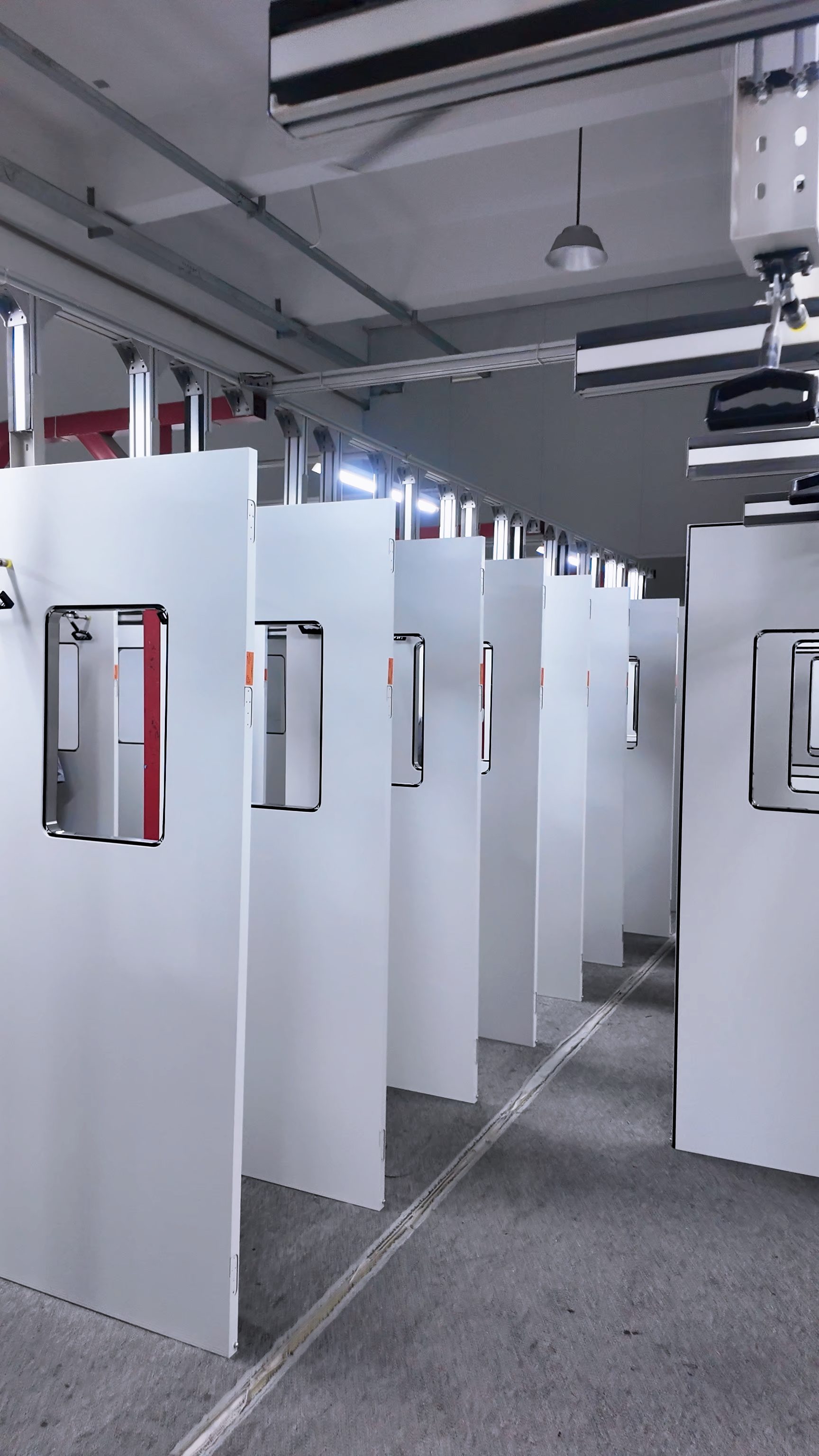
Cleanroom construction gets its reputation from the invisible details. Modular wall systems look straightforward until you realize a 1/16-inch deviation at the floor track turns into airflow turbulence and failed particle counts. We've learned to treat every panel joint like a machined part, not a drywall seam.
The interesting part is how materials fight you. Aluminum extrusions expand and contract just enough to shift a gasketed corner if the install crew rushes the torque sequence. Finish floors have waves. So we pin down hard references first, then let the panels float in a controlled envelope. It's less about forcing tight fits and more about deciding where the tolerance lives.
That shift changes how teams communicate. The best cleanroom builders obsess over shim packs, laser levels, and torque wrenches the way others obsess over square footage. When the spec says ±0.125 inch over a 20-foot run, the wall either earns its certification or it doesn't.
The Handoff Problem—and How One Contract Eliminates It
Most project failures don't happen in the middle of the work—they happen at the seams. When one team finishes a design and another takes over construction, or when a sales promise gets passed to an implementation crew, details vanish. The original intent gets reduced to a pile of documents, and nobody feels responsible for what was lost in translation. That's the handoff problem: a short moment of transfer where scope, quality, and expectations quietly unravel.
A single contract changes this because it removes the seam altogether. Instead of separate agreements for design, build, delivery, and support, one document binds every phase to the same obligations and the same party. There's no external handoff to argue about—just an internal sequence that the contractor must manage. If something drops between stages, the answer isn't a dispute over who owned which piece; it's a breach of one continuous promise.
That shift in accountability does more than prevent finger-pointing. It forces the responsible party to build real transition protocols, from shared documentation standards to milestone walkthroughs, because their own money is on the line if the handoff fails. The result is fewer surprises, faster recovery when issues appear, and a final outcome that still resembles what was originally agreed.
Certification Readiness from the First Weld to the Final Filter Scan
Certification readiness is built from the very first weld, not as a paper exercise at the end of the project. Every weld starts with a qualified procedure, a welder whose continuity is current, and consumables with traceable heat numbers. The fit-up is checked, the interpass temperature logged, and the weld map updated before the arc is even struck. That early discipline means the final certification package does not depend on hunting for missing records months later.
The work between the last weld and the final filter scan is where most failures creep in. Pressure testing confirms the boundary holds, but certification also requires that the system is clean enough for service. Flushing, passivation, and particulate counts are part of the evidence. If a single repair weld is made after cleaning, the sequence resets: re-clean, re-inspect, and re-document. Nothing moves forward until the system condition matches what the procedures demand.
The final filter scan is the last physical check before sign-off, not a substitute for earlier evidence. Each filter is scanned for pinholes, gasket seating is verified, and the results are tied to the specific housing identification. Only when every weld record, cleaning log, test sheet, and filter scan lines up without exception does certification readiness become real. It is a cumulative result, not a final stamp.
Cleanroom Performance Beyond the Punch List
Once the final walkthrough is done and the last caulk joint gets signed off, most people assume a cleanroom is ready. But the real proof comes later, when the room has to hold its particle counts during a shift change or a material transfer. Static commissioning numbers rarely match what happens when fans ramp, doors cycle, and people move through gowning. That gap is where actual performance lives.
A room can look flawless on the punch list—flush gaskets, clean welds, proper sweep edges—and still fail the moment recovery time matters. If particle counts don’t drop back to target within minutes after a disruption, the space isn’t truly supporting operations. It’s worth measuring purge rates under normal workflow, not just with the room empty and doors sealed. Those dynamic recovery times tell you more than any static certificate.
Some problems also take weeks to show up. Filter bypass leaks at the gel seal, slight pressure reversals when adjacent rooms are used, or condensation at a poorly insulated penetration won’t appear during a punch list review. That’s why treating cleanroom performance as a continuous check—rather than a one-time box to tick—keeps the facility honest long after the project team has left.
FAQ
It means the manufacturer handles everything from initial design and engineering through construction, installation, testing, and certification. You are not coordinating multiple vendors; one team delivers a ready-to-use controlled environment.
Compliance is built in from the start, not bolted on later. Air change rates, filtration efficiency, pressurization cascades, and surface materials are selected during design, then verified through particle counting and airflow testing during commissioning.
Absolutely. The layout, HVAC sizing, gowning rooms, pass-throughs, and monitoring systems are tailored to your operational workflow and contamination risk, whether it is pharma, semiconductor, medical device, or research.
One accountable team means fewer delays, fewer change orders, and no finger-pointing between designers, contractors, and certifiers. You get a single point of contact from concept to performance qualification.
Yes, and that is often where turnkey providers differ. You receive full documentation packages including DQ, IQ, OQ, material certs, and test reports, so your quality team can move straight into operations with audit-ready records.
Depending on size and classification, a small modular cleanroom might be ready in a few weeks, while a large multi-room facility can take several months. Early design freeze and off-site fabrication help keep schedules predictable.
Most can deliver ISO 8 down to ISO 4 or even ISO 3, with corresponding particle limits and air change rates. The key is matching the classification to your process requirements without over-engineering.
Yes. Many turnkey systems are modular or designed with future capacity in mind, so adding square footage, increasing air changes, or upgrading filtration can often be done with minimal disruption to ongoing operations.
Conclusion
A true turnkey cleanroom delivery doesn't stop at shipping panels and fan filter units. It includes everything from structural framing to door interlocks, gowning furniture, process utilities, and even the final test certificates. But the real engineering happens long before packing crates. Design decisions around air change rates, pressure cascades, and return air placement directly shape how particles move—or don't. For example, a low-wall return in a negative-pressure suite might be the difference between passing ISO 5 at rest and failing under dynamic loads. Modular wall systems sound simple, yet the interesting part is tolerance stacking. A 2 mm gap at the floor track can quietly undo what the ceiling grid achieves. That's why experienced manufacturers pre-cut, pre-punched, and often pre-assemble wall modules in their own facility, reducing field deviations to near zero.
The classic weak point in any cleanroom project is the handoff between design, construction, and certification. When separate vendors are involved, responsibility gaps appear exactly where performance is judged. A single-contract turnkey approach removes that friction: one team owns the welds, the sealants, the filter scans, and the final room classification. Certification readiness starts at the first weld, not at the last filter scan. Documentation builds alongside the physical room, so when the certifier arrives, every joint, pressure test, and particle count already has a traceable record. Beyond the punch list, real cleanroom performance shows up in repeatable results—stable particle counts during shift changes, recovery times after door openings, and filter life that matches design assumptions. That is what separates a supplier of cleanroom components from a manufacturer delivering an end-to-end controlled environment.
Contact Us
Contact Person: Amy Yang
Email: [email protected]
Tel/WhatsApp: 008619330882686
Website: https://www.genopharmatech.com/