

Top Hot-Dip Galvanized Angle Steel Factory: Your Source for Durable Structural Steel
2026-11-02
When structural integrity meets long-term corrosion resistance, the choice of angle steel can make or break a project. As a top hot-dip galvanized angle steel factory, Shunchen steel has quietly become the go-to source for engineers who refuse to compromise on durability. But what really separates a dependable supply partner from a costly gamble? In this post, we pull back the curtain on the production details, testing standards, and real-world performance that keep our galvanized angle steel standing strong where others fail.
Why Hot-Dip Galvanizing Outperforms Paint on Structural Steel
Paint may look sharp on day one, but it starts losing the battle the moment moisture sneaks beneath the surface. A scratch, a missed spot during application, or simple wear from handling exposes raw steel to corrosion, and from there rust spreads silently under the coating. Hot-dip galvanizing works differently: the steel is dipped into molten zinc, and the zinc forms a metallurgical bond with the iron. That bond creates a series of alloy layers harder than the base steel itself, so the protection isn't just a surface film—it's part of the steel. Even if the galvanized coating gets gouged, the surrounding zinc sacrificially protects the exposed area, a trick paint can't match.
Durability numbers tell the real story. In most atmospheric conditions, a properly galvanized structural member can go 50 to 70 years without major maintenance, while painted steel often needs recoating every 10 to 15 years—and that's if the surface prep was done right. Think about what that means for a bridge, a stadium frame, or an industrial plant: fewer shutdowns, no sandblasting crews on scaffolding, and no repeated coats of primer and topcoat. Galvanizing also covers every corner, edge, and hollow section uniformly because the steel is immersed in liquid zinc. Paint, whether sprayed or brushed, tends to build up thin at edges and inside bolt holes—exactly where corrosion likes to start.
There's also the hidden cost of paint's weak points: human error, weather windows, and touch-ups. A galvanized beam arrives on site ready to erect, with no curing time or temperature restrictions. If it gets scratched during transport, the zinc around the scratch keeps protecting it. Paint demands a clean, dry, properly profiled surface, and even a small mistake means premature failure. For structural steel that has to last decades with minimal fuss, hot-dip galvanizing simply offers a tougher, more forgiving shield—one that doesn't just coat the steel but becomes part of it.
A Walk Through Our Angle Steel Production and Coating Line
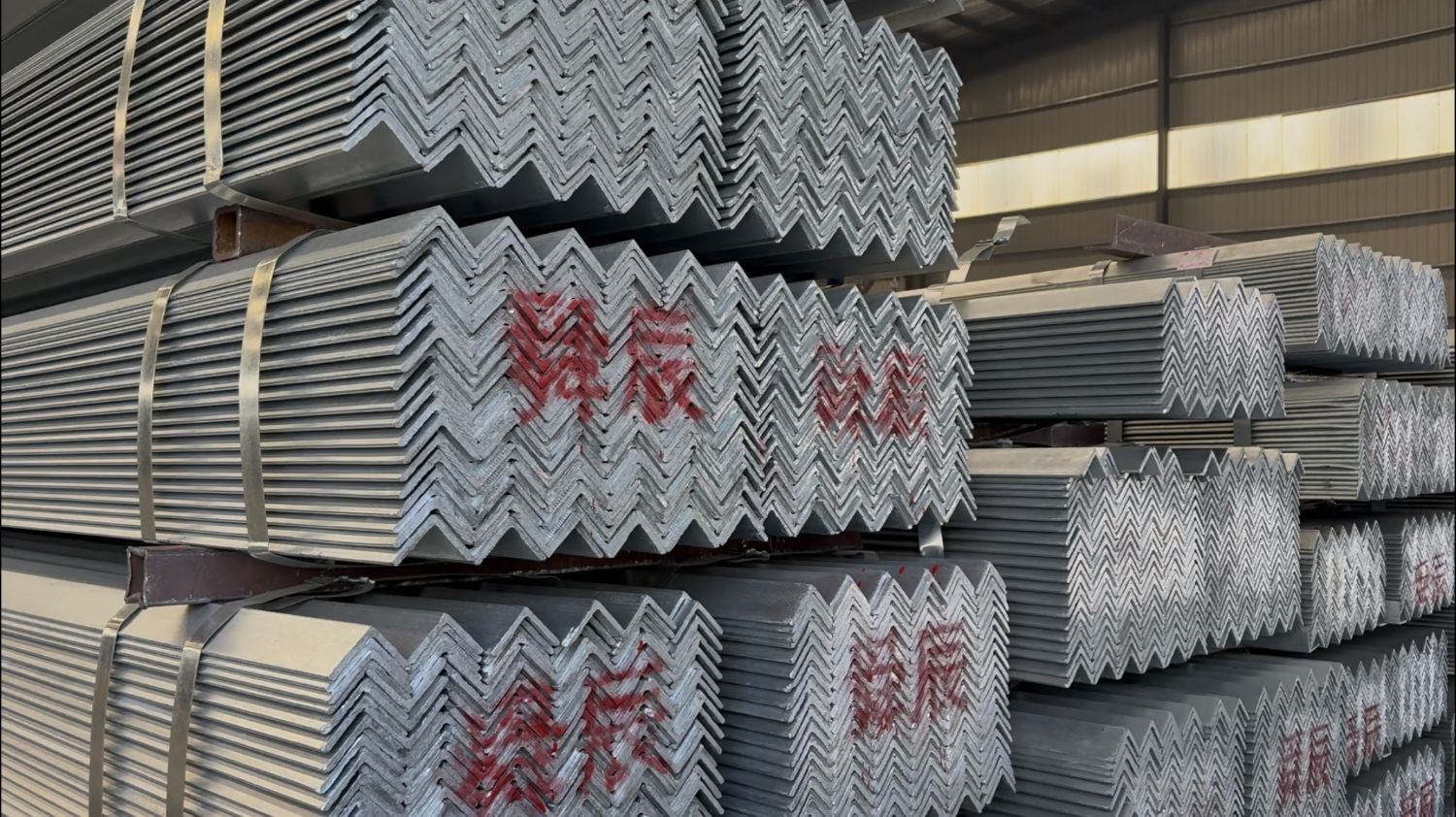
Stepping onto the floor, the first thing that hits you is the low hum of uncoilers feeding flat steel strip into the line. The coil sits heavy on the mandrel, its leading edge threading through a set of straightening rollers that take out the memory of the winding. From there, the strip passes a shear that trims the edges to exact width before it enters the cold roll forming section. It takes fourteen progressive stands to coax that flat ribbon into a crisp L-profile, each pass bending the steel a few degrees more until the legs are square and the corner sharp.
Cut to length by a flying saw that never slows the line, the angle sections then transfer sideways into the coating area. Here the steel gets a proper scrub-down inside a closed blast cabinet where fine grit strips away mill scale and surface rust. Once the dust is blown off, the pieces move through a spray booth where a zinc-rich primer goes on first, followed by a polyester topcoat in whatever color the order calls for. The wet film looks almost too thick, but the curing oven bakes it down to a hard, even skin that will shrug off years of weather.
At the exit end, inspectors work with calibrated gauges, checking leg length, thickness, and dry film depth. Rejects are rare, but when something drifts out of tolerance, a red tag goes on and the piece gets pulled aside without slowing the rest of the run. Bundles are stacked on timber dunnage, strapped tight, and tagged with heat numbers that trace every length back to the original coil. Watching the whole process from raw strip to finished, coated angle takes less than twenty minutes, though the real proof of the line is how quiet and unhurried it feels compared to older mills.
The Load Capacity Data Engineers Need Before Specifying Angle Steel
Before settling on an angle size, engineers need more than a simple area calculation. The critical load capacity data includes the minimum radius of gyration about the weak principal axis, which governs compressive buckling for single angles and often differs sharply from the strong-axis value. Section moduli for both geometric axes must be on hand because bending about the toe or heel of the angle introduces different stress distributions than bending about the leg tips. Equally important is the width-to-thickness ratio of the outstanding leg; exceeding the compact or noncompact limits from AISC Table B4.1b forces a reduction in available flexural strength due to local buckling, even if the overall member length is short.
Beyond section properties, load capacity hinges on the specified steel grade and the chosen design method. Yield strength and tensile strength set the ceiling for ASD allowable stress or LRFD design strength, but the controlling failure mode for angles is often flexural-torsional buckling rather than pure Euler buckling. Engineers must account for the effective length factor based on end connections—bolted or welded—and any eccentricity introduced by attaching to one leg, which creates an added bending moment that reduces the axial capacity. Shear lag coefficients from the connection geometry also lower the net section tensile resistance, a detail frequently missed in preliminary sizing.
Finally, the load data cannot stop at a single nominal load. The angle must be checked under the full set of load combinations, including self-weight of attached equipment, wind uplift, and thermal expansion where relevant. Deflection limits for the weak axis can control the selection over strength, especially for long-span bracing or girt applications where visible sag is unacceptable. Having a clear breakdown of dead, live, and lateral loads, along with the maximum permitted drift or sag, prevents undersizing that passes strength checks but fails serviceability.
Tough Environments Where Galvanized Angle Steel Proves Its Worth
Coastal construction sites never give steel a break. Salt spray, constant humidity, and wind-driven sand eat through unprotected metal within a few years. Galvanized angle steel holds up because the zinc coating sacrifices itself before the base iron can corrode. I've seen docks and pier supports last decades without major maintenance when the hot-dip layer is thick enough, even in splash zones where bare steel would flake away in a single season.
Wastewater treatment plants and chemical handling facilities are another proving ground. Acids, alkaline solutions, and hydrogen sulfide fumes attack structural framing around clarifiers, pipe racks, and containment areas. The galvanized bond doesn't just sit on the surface—it becomes part of the steel's outer layer through alloying, which means bumps and scratches from routine equipment traffic don't automatically expose raw metal. That kind of toughness matters when a beam supports walkways over settling tanks.
Farms and food processing operations might not sound extreme, but the combination of animal waste, cleaning chemicals, and constant moisture creates a corrosion cell that outpaces many coatings. Galvanized angle steel used for feed bunks, gate frames, and support legs in wet barns resists the ammonia and salt buildup that would otherwise cause pitting and structural failure. In these settings, the material's longevity comes down to not having to repaint or replace rusted members every few years.
What Separates a Dependable Steel Fabricator From the Rest
Plenty of shops can cut and weld steel. The ones worth keeping on speed dial do something less visible: they treat a set of drawings as a commitment, not a rough suggestion. When a dimension conflicts or a connection looks under-designed, a dependable fabricator sends a clear RFI before the saw ever touches the beam. They work inside tolerances that don’t drift just because a deadline tightens, and their shop foreman can tell you exactly where every piece stands without opening a spreadsheet.
Material traceability is another quiet differentiator. Ask for mill certs before the first plate is burned, and watch how fast the answer comes. A solid fabricator keeps heat numbers tied to each lift, labels every clip and stiffener, and never assumes that “close enough” will pass a field check. When a schedule slips, they tell you early—not after the crane is on-site—and they offer a recovery plan instead of an excuse.
Finally, look at the edges and the fit-up. Clean copes, consistent weld profiles, and beams that land square on the bolts don’t happen by accident. They come from calibrated equipment, certified welders who take pride in the backside of a joint, and a quality check that happens before paint, not after. That kind of care is hard to put in a brochure, but it shows up the first time a piece slides into place without a torch or a hammer.
Maintenance Truths About Galvanized Steel That Most Guides Skip
Most guides skip the fact that galvanized steel does not need aggressive scrubbing to stay healthy. The zinc coating naturally develops a flat, chalky patina over time, and this layer actually shields the steel beneath it. Removing that patina with abrasive pads or wire brushes strips away microns of the sacrificial zinc, which shortens the coating's life far more than most people realize. A rinse with plain water and a soft cloth is usually all that's required, unless heavy dirt or salt is present. Harsh chemical cleaners are equally risky: acidic solutions eat zinc faster than rust would attack bare steel.
Another hidden truth is that touch-up products labeled as "cold galvanizing" are not real galvanizing at all. They are zinc-rich paints that sit on the surface without forming a metallurgical bond, so they fail quickly at edges, fasteners, and any spot that flexes. True repair means re-dipping the part in molten zinc or using a zinc-based solder, and even then the repaired area will often look different from the surrounding coating because the original zinc has already aged and oxidized. That color mismatch is normal and should not be mistaken for product failure.
FAQ
The main difference is the zinc coating applied through immersion in molten zinc. This creates a metallurgical bond that protects the steel from rust and corrosion far longer than paint or cold galvanizing. For structures exposed to moisture or harsh weather, it can extend service life by decades.
It shows up in power transmission towers, highway guardrails, solar panel support frames, agricultural buildings, and marine environments. Basically anywhere strength and corrosion resistance both matter.
Yes, we regularly cut to specified lengths, punch holes, or add slots according to customer drawings. The factory has multiple punching lines and can handle both standard and non-standard dimensions.
We check each batch with magnetic thickness gauges and also run adhesion tests. Our process follows ASTM A123 or equivalent standards, and we keep records for every heat number so you can trace the coating.
Common options include Q235, Q345, S235JR, S355JR, and ASTM A36. If you need low-temperature toughness or specific chemical composition, we can discuss alternative grades as well.
Usually they are bundled with steel straps, then wrapped with water-resistant cloth or placed on pallets. For sea freight, we can also use wooden crates if the customer requests extra protection for corners or edges.
For standard sizes already in stock, we can ship within 7-10 days. Custom punching or special lengths might add a week or two, depending on quantity. We always confirm a production schedule before you place the deposit.
Yes, we can send small cut pieces or a sample bundle by international courier. This lets you inspect the zinc coating, dimensions, and overall finish before committing to a larger order.
Conclusion
When structural steel has to stand up to weather, chemicals, or constant abrasion, the difference between paint and hot-dip galvanizing shows up fast. Paint sits on the surface and chips, scratches, and peels, leaving bare steel to rust underneath. Hot-dip galvanizing metallurgically bonds zinc to the steel, so even edges and cut ends get a thick, sacrificial layer that heals small scratches. In our angle steel line, we run beams through a carefully controlled dip process after fabrication—no thin spots or missed corners. That matters because engineers need reliable load capacity numbers, not just a shiny surface. We publish full test data for each angle size and thickness, so specifying a galvanized angle does not mean guessing how much strength the coating adds or subtracts. The zinc layer is consistent enough that torque and tensile values stay predictable.
Real-world use tells the rest of the story. Galvanized angle steel holds up in marine air, wastewater plants, bridge supports, and anywhere de-icing salts or industrial runoff eat ordinary steel. That kind of durability comes from more than a good coating; it comes from a fabricator that controls every step—from raw steel inspection to final thread chasing after galvanizing. A dependable shop does not hide behind generic specs. They tell you that galvanized steel needs almost no maintenance for decades, but they also admit that wet storage stain can appear if pieces are stacked tight before the zinc fully weathers. Simple spacing and air flow fix that. Those small, honest details are what separate a top angle steel factory from one that just sells coated metal.
Contact Us
Contact Person: Max Zhou
Email: [email protected]
Tel/WhatsApp: +86 15712216177
Website: https://www.shunchensteelmaterial.com/