
Solar Charging Benches OEM Custom Manufacturing for Smart Outdoor Spaces
2026-09-28
Outdoor spaces are getting smarter, and solar charging benches are leading the shift. But off-the-shelf units rarely fit a project's exact vision—until now. zemso brings OEM custom manufacturing to the table, letting designers and developers shape every detail from materials to branding. Here's what makes that flexibility worth a closer look.
Solar Bench Fabrication That Matches Your Product Drawings
Your product drawings carry the exact dimensions, material callouts, and weld details that define what a solar bench should be. Our fabrication process treats those drawings as the single source of truth—no reinterpretation, no shortcuts. Every cut, bend, and fastener placement is checked against the CAD files before, during, and after assembly, so the finished unit lands within the tolerances you specified, not the ones we assumed.
We know that a mismatched bracket or a slightly off-angle panel mount can turn a clean install into a field headache. That's why our team works directly from your native files or PDFs, flagging any potential conflict between the solar module layout, battery enclosure, and structural frame before metal ever hits the laser. If your drawing calls for a 3-degree tilt on the seat back or a hidden wiring channel under the armrest, that's what gets built—nothing more, nothing less.
Whether you're iterating on a custom bench for a municipal pilot or scaling a production run, the goal is simple: the bench that arrives on site should look and function like it walked off your drawing sheet. No surprises, no creative liberties, just fabricated steel and integrated solar that match the design you signed off on.
Outdoor Charging Stations Designed for Constant Use
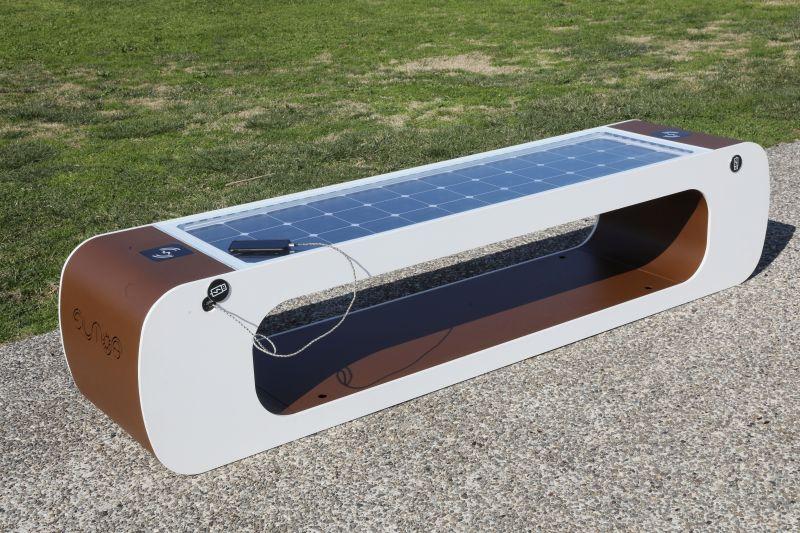
These stations are built around a simple idea: they should work every time someone plugs in, no matter the weather or how many people came before. The housings use powder-coated aluminum and sealed gaskets, so moisture, dust, and salt spray stay out. Internal components sit on vibration-dampened mounts, which keeps connectors from loosening after months of daily use.
Heat is the biggest enemy of continuous charging, so the design routes airflow across the power modules before it exits through louvered vents. That passive cooling means no moving parts to wear out, and the stations can hold their full rated output through summer afternoons without throttling. Power delivery electronics are also over-specified by about twenty percent, leaving headroom for long sessions when several vehicles charge at once.
Every port gets its own current sensor and isolation relay. If a cable gets damaged or a vehicle draws erratically, only that port shuts down while the rest keep running. The faceplates and holsters are rated for at least 100,000 insertion cycles, so even high-traffic fleet yards won't wear them out quickly.
Custom Enclosures for Solar-Powered Public Seating
Public seating powered by the sun has moved beyond the clunky, off-the-shelf boxes of early prototypes. The real shift happens when the enclosure itself is treated as a design element rather than an afterthought. Custom enclosures let cities, campuses, and transit hubs match the seating to the surrounding architecture, whether that means powder-coated steel with laser-cut patterns or weather-resistant hardwoods routed for hidden cable runs.
On the technical side, bespoke housings solve problems that generic solar benches usually ignore: venting for battery heat, angled panels that still shed rainwater, and lockable compartments that don't look like utility boxes. A well-built enclosure also protects the charge controller and wiring from vandalism and curious fingers, all while keeping the USB ports or wireless charging pads at a natural height for someone sitting down.
Maintenance teams benefit too. Custom designs can include front-access panels, modular battery trays, and quick-disconnect wiring so a single technician can swap a failed component in minutes without dismantling the whole bench. That kind of practical thinking is what turns a pilot project into a permanent streetscape fixture.
Weather-Sealed Benches with Integrated USB Charging
Most outdoor benches treat power as an afterthought, but these units build the charging circuitry directly into the armrest, sealing every port behind a silicone gasket and a spring-loaded cover. Rain, sleet, and road spray slide off the powder-coated aluminum body without reaching the contacts, and the internal wiring runs through a drainage channel that prevents condensation from pooling.
Each USB module is tested to survive repeated freeze-thaw cycles and high-humidity coastal air, not just a quick splash in a lab. The connectors stay accessible even when the bench surface is wet, so you can top up a phone without wiping the port dry first. A low-profile LED ring around each outlet gives a subtle status glow at dusk without turning the seating area into a beacon.
Installation doesn't require trenching for a separate power pedestal; the bench connects to a single weatherproof conduit stub at the base. That keeps the visual footprint clean and leaves more open space for foot traffic, while the sealed compartments remain serviceable from the side panel if a component ever needs replacement.
Smart Furniture Manufacturing for Municipal Buyers
Municipal procurement often treats furniture as a static purchase, but smart manufacturing flips that assumption. When a city orders desks, shelving, or seating for public buildings, the production line can now adjust cutting patterns, edge banding, and joinery based on real-time demand data rather than fixed batches. This means municipalities get pieces that fit exact room dimensions and usage patterns without paying custom-shop premiums.
The real advantage shows up in compliance and documentation. Smart factories track every board, adhesive, and finish with digital records, making it easier for municipal buyers to verify fire ratings, indoor air quality standards, and recycled content thresholds. That traceability matters when public projects face audits or need to prove sustainable sourcing commitments.
Durability also improves because sensors and automated inspection catch defects before assembly. For high-traffic civic spaces—libraries, community centers, permit offices—that translates into longer service life and fewer replacement cycles, which stretches tight municipal budgets further.
Low-Volume OEM Runs for Pilot Smart City Projects
Pilot smart city deployments rarely need tens of thousands of identical units. Instead, they call for a few hundred carefully built devices that can survive real-world streets, weather, and power fluctuations. Low-volume OEM runs fill this gap by letting project teams order sensor nodes, gateways, or control modules in quantities that match a trial’s actual scope, without paying for excess inventory or waiting on massive production lines.
Working with an OEM partner on short runs also opens the door to iterative hardware changes. If a housing cracks during installation or an antenna placement causes interference, the next batch can incorporate fixes within weeks rather than months. This kind of tight feedback loop is essential when a city tests new traffic, lighting, or air-quality systems across a handful of neighbourhoods before committing to wider rollout.
The main challenge is finding a manufacturer willing to accept smaller minimum order quantities without inflating per-unit costs. Some suppliers specialise in exactly this type of flexible production, often using modular designs or semi-automated assembly to keep setup time low. For city planners and integrators, choosing such a partner early means the pilot phase stays focused on proving technical and operational value, not on managing oversized supply chains.
FAQ
Absolutely. We start from the frame material—powder-coated steel, aluminum, or even sustainable bamboo—then move to color, seating surface, armrests, and integrated lighting. Clients often send us their brand guide or a photo of the surrounding architecture, and we adapt the silhouette and finish so the bench reads as part of the existing space rather than a generic add-on.
We use high-efficiency monocrystalline panels paired with a lithium iron phosphate battery bank sized to your location's worst-case solar window. Even with heavy overcast, the bench typically holds enough reserve for 3–5 days of normal phone charging. The system also supports a backup grid connection if you need guaranteed uptime in a shaded park or courtyard.
Marine-grade stainless hardware, IP65-rated enclosures, and conformal-coated circuit boards are standard on every build. For coastal salt exposure we add an anti-corrosion primer; for sub-zero climates we use heated battery compartments and low-temperature charge controllers. The charging ports themselves are sealed with silicone flaps and tested in driving rain.
Yes. We treat the bench as a modular smart hub. The seat structure can house a Wi-Fi access point, Bluetooth speaker grilles, air quality or noise sensors, and even a small digital display for local announcements. You choose which modules to include, and we run the cabling through hidden channels so the exterior stays clean.
We provide a 5-year structural warranty and 3-year warranty on electronics. After installation, we keep a dedicated engineering contact for your team and can ship replacement parts from regional warehouses to minimize downtime. If you prefer local servicing, we also train your maintenance staff with video guides and live calls.
Usually 8–12 weeks. The first two weeks are design confirmation and prototyping—we send a 3D render, then a functional sample if requested. Production takes about 4–6 weeks, followed by strict quality checks and then shipping. Large orders or complex integrations may add 2–3 weeks, but we always give a locked timeline before you sign off.
Yes, we often reverse-engineer from a client's photos, drawings, or even a physical sample. We keep the same proportions and visual details while upgrading the internals to modern solar and charging standards. This is useful for municipalities that want to expand a seating family without changing the overall look.
Our standard MOQ is 10 units per design, which allows you to pilot a small installation before committing to a citywide rollout. For larger projects, we offer tiered pricing, and for very small pilots we can sometimes do 5 units with a slightly higher per-unit cost.
Conclusion
From initial CAD files to final assembly, our solar charging bench fabrication follows your product drawings with tight tolerances and material consistency. Every bench is built around outdoor charging stations designed for constant use—reinforced frames, tamper-resistant ports, and high-cycle batteries that survive daily public interaction. We craft custom enclosures for solar-powered public seating in aluminum, steel, or composite finishes, balancing thermal management, cable routing, and ergonomic seating depth. Weather-sealed benches with integrated USB charging use gasketed seams, drainage channels, and UV-stable powder coating to withstand rain, snow, and coastal humidity without service interruptions.
Smart furniture manufacturing for municipal buyers means we handle procurement documentation, compliance testing, and on-time delivery to parks, transit hubs, and university campuses. For low-volume OEM runs in pilot smart city projects, we offer flexible MOQs, rapid prototyping, and shared tooling options that keep per-unit costs reasonable while preserving design integrity. Whether you need 20 units for a neighborhood trial or 500 for a citywide rollout, our process removes the friction between concept and installed public infrastructure.
Contact Us
Contact Person: Leo
Email: [email protected]
Tel/WhatsApp: +86 18901905138
Website: https://www.zemsogroup.com/