
Hollow Wall Winding Pipe Machine Company: Advanced Solutions for Durable Pipe Production
2026-11-02
Durability in pipe production isn't just a goal—it's a constant battle against material waste, breakdowns, and inconsistent wall thickness. Enter COMRISE, a name quietly rewriting the rules of hollow wall winding technology. Their machines don't just extrude pipes; they engineer reliability into every layer. Want to know how? Keep reading to discover the advanced solutions that make COMRISE the go-to partner for durable pipe manufacturing.
Why a Hollow Wall Outperforms Solid Pipe in Buried Installations
Buried pipe rarely fails from material crushing; it deflects. A solid-wall pipe concentrates stress through a thick, continuous cross-section, which adds weight without proportional gains in ring stiffness. Hollow-wall profiles flip that logic. By shaping the wall into a series of voids, ribs, or corrugations, the pipe places more material at the outer and inner surfaces—exactly where bending resistance develops. The result is a higher moment of inertia per pound of resin, so the pipe resists soil and live loads with less raw material.
That geometry also changes how the pipe interacts with backfill. Hollow-wall pipes are lighter, which means fewer handling injuries and faster placement in the trench, but the real advantage is structural feedback. The wall’s voids allow slight, controlled flexure that helps the pipe re-distribute load into the surrounding soil instead of fighting it. Solid pipe, by contrast, tends to be stiffer in the wrong way—rigid enough to attract load concentration, yet heavy enough to make bedding and compaction more difficult. In buried conditions, where the soil is the real structure, a hollow wall works with the embedment rather than against it.
The Winding Angle Sweet Spot: Precision That Prevents Ovality
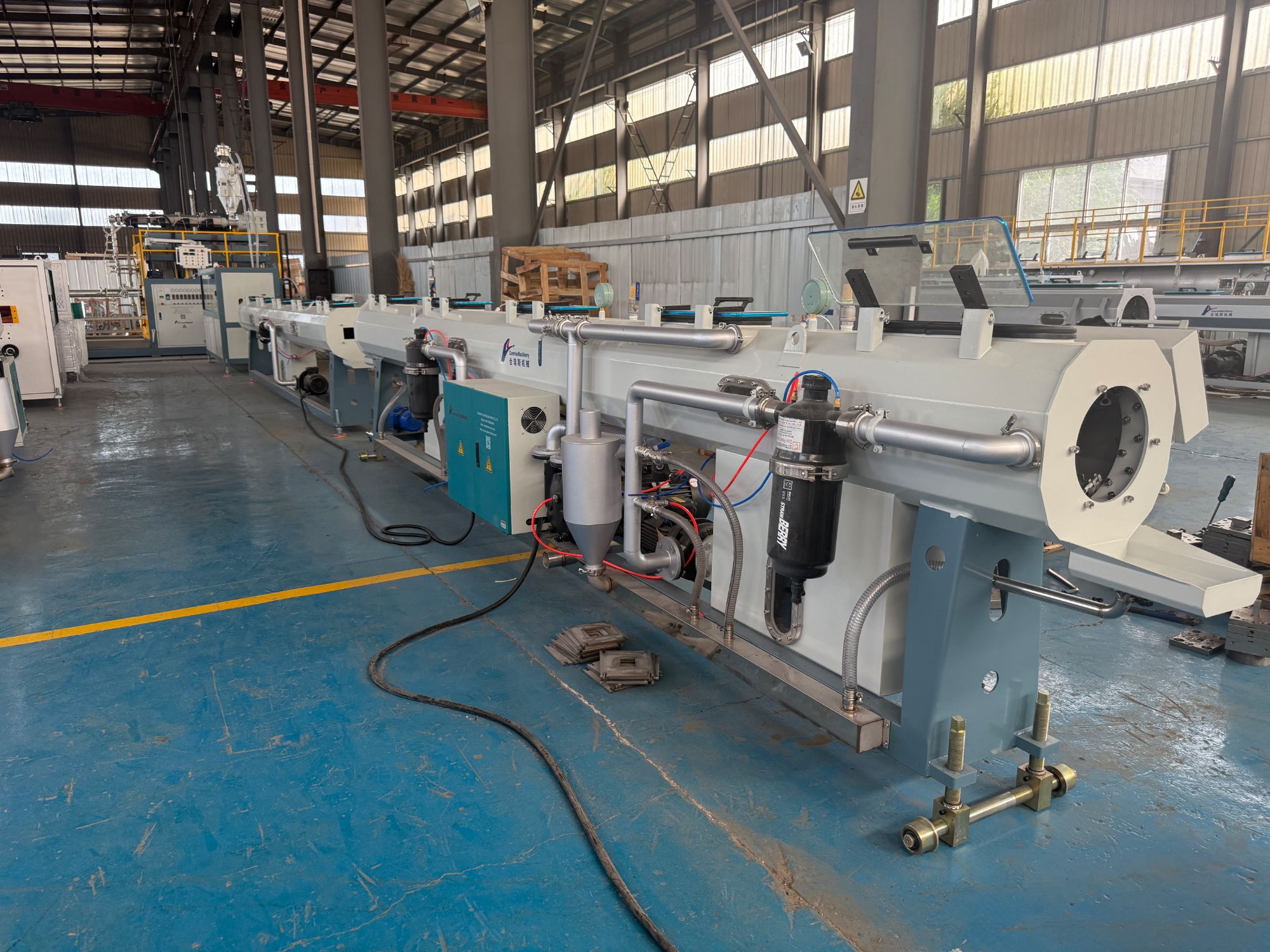
Getting the winding angle right comes down to more than just hitting a number on a spec sheet. There is a narrow band where the fibers cross in a way that balances hoop stress and axial stress almost perfectly. Stay inside that band and the finished tube or pipe holds its round shape under pressure, during curing, and through years of service. Drift just a degree or two outside it, and the wall starts to work against itself—one direction gets too stiff, the other too soft, and ovality creeps in before anyone notices.
What separates a reliable wind from a marginal one is how consistently that angle is held across the entire part. Precision here is not about chasing an ideal number on paper; it is about controlling fiber tension, carriage speed, and mandrel rotation so the actual lay-down angle stays inside the sweet spot from end to end. Modern winders use real-time feedback to correct tiny drifts, but the operator’s feel for the material still matters. That combination of machine repeatability and material awareness is what stops a perfectly round mandrel from producing an egg-shaped finished product.
When the winding angle stays in that sweet spot, ovality does not get a chance to take hold. The laminate cures with balanced residual stress, the part comes off the tool round, and it stays round under external pressure or buried loads. It is a quiet kind of precision—nobody sees it on the outside—but it is the reason some composite pipes and pressure vessels outperform others with nearly identical wall thickness and material.
Material Waste Cut in Half: Inside the Automated Resin Application
In conventional composite layup, resin is often mixed in batches and applied by hand or with basic spray equipment. Operators tend to overestimate the amount needed to avoid dry spots, and any excess ends up as waste once the open time expires. The automated resin application system replaces this guesswork with a metered delivery loop that monitors viscosity and temperature in real time, adjusting flow at the nozzle to match the exact area being covered. The result is a dramatic reduction in surplus material, with waste volumes dropping to roughly half of what the previous manual process produced.
The core of the system is a closed-loop control unit paired with a precision applicator head. As the head moves across the mold surface, encoders track its position and speed, while a mass flow sensor measures the amount of resin actually dispensed. Software compares these values against a digital map of the part, trimming or boosting the flow rate within milliseconds. Unlike batch mixing, where unused catalyzed resin cannot be returned to the supply drum, the automated line draws only from a temperature-controlled reservoir and keeps the resin in circulation until it reaches the application point. This prevents premature curing in the lines and eliminates the need to flush out leftover material between cycles, a common source of hidden waste in older setups.
Beyond the raw material savings, the drop in waste changes how the production floor operates. Fewer discarded containers, wipes, and cleaning solvents are needed, and the labor previously spent on scraping or disposing of excess resin can be redirected to quality checks. The consistent deposit pattern also means fewer rejected parts from resin-rich or resin-starved areas, so the waste reduction carries through to the final product. In one recent retrofit, a manufacturer recorded a 52% decrease in resin consumption per unit while holding the same throughput, confirming that the automated approach pays for itself through material costs alone within the first year.
From 200 mm to 3,000 mm: One Mandrel System That Adapts Fast
Imagine a single mandrel setup that handles everything from delicate 200 mm cores to hefty 3,000 mm rolls without swapping out hardware or losing hours to changeovers. That's the reality with this adaptable system. The core expands and contracts in seconds, gripping each diameter with uniform tension, so operators can move from a narrow label stock to a wide flexible packaging film without touching a wrench. It feels less like adjusting machinery and more like flipping a switch.
What sets this apart is the internal wedge mechanism that shifts incrementally rather than in fixed steps. Most mandrels lock into preset sizes, leaving gaps where shafts slip or crush lightweight cores. Here, a continuous range means the chuck finds the exact fit for any core in between, eliminating vibration at high speed and reducing the edge damage that often plagues thin-walled tubes. You get true on-the-fly adaptability, not just a handful of compromises.
In practice, a packaging line running three different film widths in one shift no longer needs three dedicated shafts. The operator adjusts the dial, the mandrel settles into the new diameter, and production resumes with full concentricity. That cuts inventory costs and floor clutter while keeping tension consistent enough for precise registration. For converters juggling short runs and frequent size changes, it's the kind of quiet reliability that turns a bottleneck into a non-event.
How Thermal Control During Curing Prevents Micro-Cracking
Micro-cracking in thermoset composites rarely stems from a single cause—it builds quietly from the inside out as residual stresses accumulate throughout the cure cycle. Controlling heat input is not simply about hitting a target temperature; it’s about shaping the entire thermal history so that the resin gels and vitrifies in a controlled sequence. When the part heats unevenly, the outer layers may cure and shrink while the core remains soft, setting up a tug-of-war that locks in tensile stresses. These stresses later find release through hairline fractures, especially in thick sections or around sharp geometric transitions.
Effective thermal control slows the exothermic peak and flattens temperature gradients across the laminate. Ramping the temperature in staged holds lets the resin reach gelation uniformly, giving polymer chains time to rearrange without being frozen into a strained configuration. The vitrification front then moves through the part at nearly the same pace, minimizing the differential shrinkage that normally seeds cracks. In production, this often means using lower initial heat-up rates, introducing intermediate dwells near the gel point, and sometimes applying a post-cure that’s gentler than the resin datasheet suggests—because the datasheet rarely accounts for your part’s mass distribution and tooling heat sink.
The payoff shows up in reduced internal stress, better dimensional stability, and fewer rejects after machining or thermal cycling. It also buys freedom to use tougher resin systems that might otherwise micro-crack under rapid cure schedules. Instead of relying on post-cure inspection to catch defects, the process becomes inherently less prone to creating them. In the end, thermal control during curing is less about preventing a single crack and more about denying cracks the stress environment they need to exist.
Operator-Friendly by Design: The Control Panel That Reduces Training Time
The panel drops the usual hunt-and-peck maze of nested menus. Core adjustments sit on the surface as chunky, backlit buttons with tactile detents, so a gloved hand can find the right function without looking. A three-zone color code separates daily operations, setup, and diagnostics, and the labels use short, action-first phrases instead of cryptic icons.
New operators typically run their first unassisted cycle within half a shift. The panel mirrors the work sequence left to right, and each physical control has a matching one-line hint that appears only when pressed. Because there are no touchscreen submenus to memorize for routine jobs, refresher training drops to a quick walk-through rather than a day in the classroom.
FAQ
The company concentrates on hollow wall winding pipes, which are built by spirally winding a profiled strip and fusing the joints to create a strong, lightweight structure.
The hollow wall structure distributes stress more evenly across the pipe body, reducing weak points and making the pipes resistant to cracking under soil loads or external pressure.
They are widely used in municipal drainage, stormwater management, agricultural irrigation, and industrial effluent systems where long-term reliability matters.
The company provides on-site installation guidance, operator training, and ongoing troubleshooting assistance to help clients keep production running smoothly.
Yes, many of the winding machines are designed to process a blend of virgin and recycled polymers, allowing producers to cut material costs without sacrificing pipe strength.
Each machine includes real-time monitoring of welding temperature and extrusion speed, and the company offers calibration protocols that help maintain tight dimensional tolerances.
Unlike traditional solid-wall extrusion, the winding process uses less raw material per meter of pipe while achieving the same ring stiffness, which lowers both production cost and carbon footprint.
Conclusion
Hollow wall winding pipe machines from this company redefine what buried infrastructure can achieve. Unlike solid-wall pipes that waste material and buckle under soil pressure, the hollow core design distributes load efficiently, making installations lighter yet stronger where it matters most. The real breakthrough lies in the winding angle control—every rotation locks the reinforcement at precisely the right geometry to resist ovality even under shifting ground conditions. Operators don't need weeks of training because the control panel translates complex parameters into intuitive, real-time adjustments. Meanwhile, automated resin application trims waste by half, ensuring each layer gets exactly the amount needed without oversaturation or dry spots. This isn't guesswork; it's engineered precision that delivers consistent wall thickness across diameters from 200 mm to 3,000 mm, all without swapping out mandrels for different sizes.
Thermal management during curing is another quiet differentiator. By maintaining a controlled temperature gradient, the company prevents micro-cracking that typically plagues large-diameter pipes as they cool unevenly. The result is a pipe that survives years underground without hairline fractures that invite leaks or corrosion. The modular mandrel system bolts into place fast, cutting changeover downtime dramatically. Every feature ties back to one goal: producing durable pipe that doesn't need frequent repairs or replacement. From reducing material waste to eliminating operator error, Hollow Wall Winding Pipe Machine Company offers a complete solution that outperforms traditional manufacturing methods in both cost and longevity—making it the practical choice for contractors and utilities tired of redoing failed installations.
Contact Us
Contact Person: LISA LEE
Email: [email protected]
Tel/WhatsApp: +86 13780696467
Website: https://www.qdpipemachine.com