
China OEM Industrial AGV Bin Factory Delivers Custom Automated Guided Vehicle Storage Solutions
2026-11-04
What if your AGV bins were designed around your floor layout, load patterns, and throughput targets—instead of forcing your automation to adapt to generic containers? Lanyuda, a China OEM industrial AGV bin factory, makes that possible with custom automated guided vehicle storage solutions engineered from the ground up.
Bin Dimensions Built Around Your AGV, Not the Other Way Around
Most off-the-shelf bins assume a generic footprint that rarely matches the actual reach, lift height, or turning radius of your AGV. That mismatch forces you to add adapter plates, modify racking, or accept wasted space. Instead, start from the AGV's physical envelope: its fork spacing, top plate dimensions, sensor blind zones, and maximum stable payload offset. Let those numbers dictate bin width, depth, and base geometry.
A bin that is wider than the AGV's chassis can destabilize cornering, even if the total weight is within spec. Tapered side walls or a slightly recessed bottom lip can keep the center of gravity low without sacrificing usable volume. If your AGV uses underride forks, the bin's tunnel clearance and entry height need to match the lift stroke, not the other way around. Small changes here prevent sensor occlusion and reduce the need for field-programmed slowdowns.
Custom bins also let you move away from rectangular defaults. Asymmetric shapes, split compartments, or angled faces can follow the AGV's navigation path and docking angles. This cuts cycle time and lets you use the full payload rating without pushing stability margins. The goal is a bin that behaves like part of the vehicle, not a loose box placed on top of it.
A Walk Through the AGV Bin Production Floor
The first thing you notice on the AGV bin production floor is the low, steady hum of automated guided vehicles gliding between workstations. They don't rush, but they never stop moving either. Steel frames for bins roll in from the laser cutting area, edges still warm, and get lifted into position by robotic arms that work with a kind of unhurried precision. The air smells faintly of ozone and hot metal, and every few seconds a welder throws a short burst of sparks that scatter across the concrete like tiny orange hail.
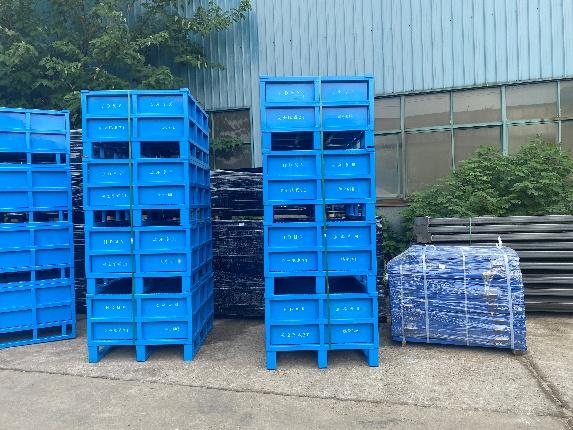
Midway down the line, a quality control station sits between two assembly cells. Here, a technician with a tablet walks around each bin, checking weld depth and corner alignment against a digital model. She taps the screen, and an RFID tag on the bin's base records the inspection result before the AGV carries it forward. Nearby, stacks of finished bins wait in marked floor zones, their powder-coated surfaces reflecting the overhead lights in soft gray and blue. It's quiet enough that you can hear the click of a torque wrench and the occasional beep of a forklift reversing somewhere behind the paint booth.
At the end of the floor, each bin goes through a short test cycle: the AGV docks, lifts the bin, and confirms the load capacity with a quick strain gauge reading. A final visual check under bright lamps catches any scratches or missed welds. Once cleared, the bin is tagged and moved to the outbound staging area. Leaving the floor, you pass rows of them waiting for shipment—identical at a glance, but each one carrying its own small history of stamps, scans, and adjustments from the last forty minutes.
Joints and Coatings That Endure Daily Docking Cycles
Marine loading arms, hatch covers, and quick-release mooring hooks all share one punishing requirement: they must survive being connected and disconnected hundreds of times a year. Each cycle scrapes mating surfaces, flexes seals, and works micro-cracks into protective layers. Joints that are merely strong on day one often fail quietly after a few months of repeated docking, when fatigue and fretting overtake the original material properties. That is why successful designs treat the interface between moving parts as a wear system, not a static connection.
One of the most effective upgrades is the use of duplex coatings: a thermally sprayed zinc or aluminum base for cathodic protection, sealed with a tough polyurethane or epoxy topcoat that can absorb impact and resist abrasion. In high-wear hinge points, replaceable polymer bushings or self-lubricating composite washers are often specified instead of bare steel pins. The goal is to shift wear away from expensive structural members and onto cheap, easily swapped components. For bolted flanges that are opened and closed daily, spring-energized PTFE seals have proven far more tolerant of misalignment and thermal cycling than conventional O-rings.
Validation matters as much as material choice. Manufacturers now run accelerated docking simulators that mimic ten years of daily cycles in a few weeks, combining angular misalignment, salt spray, and cyclic loading. The best-performing joints show not just high tensile strength but a stable coefficient of friction and minimal loss of coating thickness after thousands of cycles. In real port operations, those differences translate directly into longer maintenance intervals and fewer emergency shutdowns.
The Limits of Standard Containers in Automated Storage
Most off-the-shelf totes and bins are built for manual handling first. Their sides flex under clamp pressure, their bases sag when loaded above half capacity, and their lip designs vary enough to throw off automated grippers by a few millimeters. Those small deviations compound quickly in a high-density storage aisle, leading to dropped items, missed scans, and cycle count errors that eat into the promised throughput of an automated system.
Another less obvious constraint is how standard containers interact with racking and shuttle tolerances. A bin that works fine on a static shelf may warp after repeated transfers, especially in environments with temperature swings or humidity. Warped sidewalls can make a shuttle misjudge the pick face, or leave a container wedged between uprights. Retrofitting sensors or adding reinforcement strips only partially solves the problem because the original molding was never designed for that kind of repetitive mechanical stress.
Finally, there is the data layer. Standard containers rarely come with embedded identifiers that survive automated scanning from multiple angles. Printed labels peel, QR codes get obscured by stretch wrap or dust, and RFID tags are often an afterthought. When the container itself cannot reliably tell the system what it holds, the automation must rely on external tracking, which adds points of failure and erodes the very speed the equipment was meant to deliver.
From CAD Model to Finished Bin: A Four-Week Timeline
The CAD model rarely survives first contact with the shop floor. That first week is spent reconciling the clean digital shell with the realities of sheet metal: bend radii that eat into internal clearance, weld distortion that tugs a face out of square, a brace that blocks the lid from opening fully. We adjust the model only where it matters, keeping changes minimal so the bin still works as designed.
By the middle of week two, the laser-cut panels are on the bench, and the timeline shifts from screen to hands. Welding and grinding take longer than anyone expects, not because the work is complex, but because each corner has to be checked against a framing square before the next pass. Week three brings the parts together: casters bolted on, lid hinges set with a deliberate two-millimeter gap, and the whole frame sanded until the seams disappear. Powder coating goes on midweek, and the bin sits in the curing oven overnight.
Week four is quieter. The finish gets inspected under shop lights, not just daylight, because runs and thin spots hide in warm reflections. Touch-up is rare but not impossible. The bin is wrapped, labeled, and rolled to the loading dock. Four weeks from a screen model to a bin that will outlast the CAD file that started it.
Damage-Free Cross-Border Delivery for Custom AGV Bins
Cross-border shipments put custom AGV bins through rough forklift handling, prolonged vibration, and sudden temperature shifts. Most damage starts small—hairline cracks near the guide rails or loosened stacking lugs—then turns critical when the bin reaches the automated line. We run loaded bins through simulated transfer cycles before dispatch, checking that docking features, latch alignment, and wheel pockets survive the same shocks they will meet in transit.
The protective approach relies on the bin’s own structure instead of disposable padding. Corner reinforcements, part-specific dunnage, and lids that stay rigid under pressure keep contents stable without extra wrapping. Since cross-border routes often include customs checks, quick-release panels allow inspectors to look inside without cutting restraints or forcing the bin open, so the packaging stays intact for the remaining leg.
Once the bins arrive, AGVs can use them immediately because mounting points and positioning aids have not shifted. Impact indicators fitted to each unit help trace any rough handling back to a specific transfer point, which makes it easier to refine the route or adjust carrier handling instructions. That keeps unplanned repacking and line stoppages to a minimum.
FAQ
Nearly every dimension can be adjusted: length, width, height, load capacity, and wheel or roller placement. The coupling interface is also tailored to match the docking mechanism of a specific AGV model, whether it uses pin hooks, latches, or lift platforms.
They appear most often in automotive assembly lines, electronics manufacturing, pharmaceutical distribution, and e-commerce fulfillment centers. Any operation that moves bins between picking stations and production cells with AGVs can benefit from this type of storage system.
Yes. The factory routinely builds bins for AGVs from major brands like MiR, Quicktron, Geek+, and standard European or Asian platforms. As long as the interface drawings or mounting hole patterns are provided, the bins can be matched precisely.
Mild steel with powder coating works for standard loads, while stainless steel is an option for washdown or corrosion-prone areas. Aluminum is lighter and still rigid enough for many electronics or pharmaceutical tasks. Anti-static coatings are also available for sensitive components.
Before production, a 3D model is created and a virtual fit check is run using the AGV's mounting specs and clearance envelope. Then a pre-production sample is built and tested on an actual or simulated AGV docking station to confirm alignment and locking.
A prototype usually takes 10 to 15 working days after drawing approval. Once the sample is signed off, full production runs of 100 to 500 units typically ship within 20 to 30 working days, depending on the complexity of the finish and the current factory schedule.
Absolutely. Dividers can be welded or bolted in, document holders added, RFID chip brackets installed, and laser-cut labeling areas applied. These extras are integrated without compromising the bin's structural strength or docking accuracy.
Every bin goes through dimensional inspection with CMM or laser measurement on critical interface points, weld integrity checks, and a load test at 125% of the rated capacity. Surface coating thickness and adhesion are also tested before packing.
Conclusion
Standard off-the-shelf storage containers rarely survive the repetitive docking and positioning demands of automated guided vehicles. That mismatch is the starting point for this China-based OEM AGV bin factory, which designs each bin around the exact footprint, lift height, and sensor clearance of a customer’s AGV rather than forcing the vehicle to adapt. On the production floor, laser-cut steel sheets move through press brake forming, robotic welding, and powder coating, while joints are reinforced and coated specifically to endure thousands of daily dock-and-release cycles without edge wear or misalignment. The result is a bin that behaves less like a generic box and more like a precision component in the automated storage loop.
From approved CAD model to a finished bin, the typical lead time is four weeks, including in-house prototyping and fitment checks before full production. Because many clients operate overseas, the factory packs bins with custom foam cradles, edge protectors, and steel-frame crating so they arrive without scratches, dents, or bent flanges. This combination of AGV-specific sizing, durable joint treatment, and careful cross-border logistics makes the factory a practical alternative to reworking standard containers, which almost always fall short in automated storage systems.
Contact Us
Contact Person: Johnny
Email: [email protected]
Tel/WhatsApp: +86 18151010686
Website: https://lydstorage.com