

China Distal Access Catheters: Advancing Neurovascular Interventions
2026-10-05
In the rapidly evolving field of neurovascular interventions, the tools we choose can mean the difference between a routine procedure and a life-saving breakthrough. China's distal access catheters are quietly reshaping how clinicians navigate the brain's most delicate pathways—offering unprecedented trackability, stability, and reach. Yet, not all catheters are created equal. Behind this shift stands INT, a manufacturer pushing beyond conventional limits to engineer devices that don't just follow the anatomy, but anticipate the clinician's next move. This post dives into the engineering principles, clinical advantages, and real-world impact of these advanced catheters—and why INT is becoming the name behind the next generation of neurovascular care.
China's Distal Access Catheters Meet the Demand for Faster Stroke Care
The push to shorten door-to-puncture times in stroke centers across China has put distal access catheters at the center of acute ischemic stroke intervention. These devices are now designed with softer distal segments and reinforced proximal shafts, allowing neurointerventionalists to navigate tortuous intracranial vessels more quickly and with less vessel trauma. In busy thrombectomy cases, that translates directly into faster clot retrieval and fewer device exchanges.
Hospitals in major Chinese cities are adopting newer generations of distal access catheters that pair larger inner diameters with improved trackability. The larger lumen supports aspiration techniques and balloon guide catheter compatibility, while the flexible tip reaches the M1 or even M2 segments without buckling. Clinicians report that this combination reduces the need for multiple catheter passes, which is critical when every minute of ischemia increases the risk of permanent disability.
Beyond the device itself, local manufacturing and supply chain improvements have made these catheters more available to stroke networks outside top-tier centers. Faster restocking and lower costs mean that regional hospitals can maintain the inventory needed for 24/7 mechanical thrombectomy services. As a result, patients who previously would have been transferred to a provincial capital now have a better chance of receiving reperfusion therapy within the golden hour, directly addressing the demand for faster stroke care across the country.
From Polymer Blends to Braided Shafts: What Sets Chinese Catheters Apart
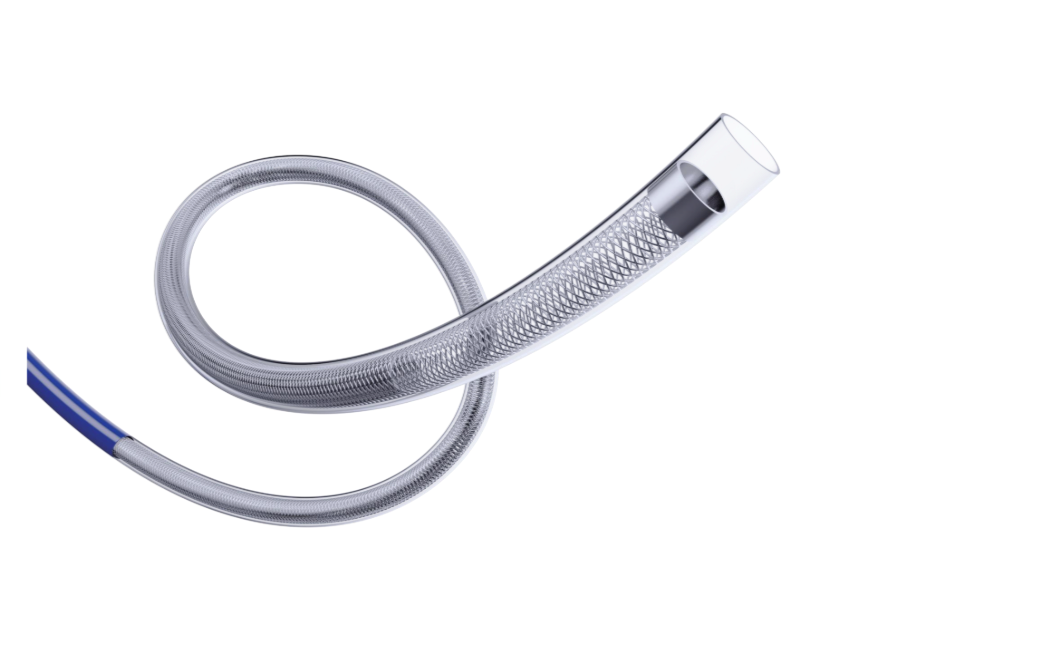
Chinese catheter manufacturing has quietly moved past the copycat stage by focusing on polymer science at the granular level. Instead of relying on off-the-shelf Pebax or nylon grades, many facilities now blend custom ratios of polyether block amides with radiopaque fillers and lubricious additives, tuning shore hardness and flexural modulus for specific vascular beds. This lets a single base resin serve neuro, coronary, and peripheral designs without sacrificing pushability or kink resistance.
The braided shaft tells a similar story of refinement. Rather than defaulting to standard 16-wire stainless steel coils, Chinese production lines often use flattened or ribbon wire in mixed stainless-nitinol configurations, varying pic count and pick angle along the shaft length. This graduated braid pattern gives proximal columns more torque transmission while keeping distal segments soft enough to track tortuous anatomy. Automated winding and laser welding stations maintain tension consistency that earlier generations of manual assembly could not match.
What really separates these catheters, though, is the integration of material and process under one roof. Polymer blending, braiding, reflow, and hydrophilic coating are increasingly coupled with in-line dimensional checks and burst testing at multiple stations. That closed-loop approach reduces lot-to-lot drift and allows quick iteration for OEM partners. The result is not a cheaper clone, but a device family where shaft behavior is engineered from the melt onward rather than tuned by trial and error.
How Chinese Neurointerventionalists Are Using Distal Access in Daily Practice
In many Chinese stroke centers, the distal access catheter has quietly become a workhorse rather than an occasional tool. Neurointerventionalists there tend to favor longer, softer-tipped designs that can be parked in the petrous or cavernous internal carotid artery without causing vasospasm, even when the anatomy is unforgiving. Unlike the more protocol-driven approaches seen elsewhere, the decision to use distal access often hinges on the operator's tactile feedback during the initial diagnostic run, not just on standardized guidelines.
For mechanical thrombectomy, a common daily practice involves advancing the distal access catheter over a microcatheter and microwire up to the M1 segment, then using it as both a suction channel and a stabilizing platform for stent retriever deployment. Chinese operators frequently pair imported distal access catheters with domestically manufactured stent retrievers, and they are more willing to reposition the catheter mid-procedure if the first pass fails. This adaptive, resource-conscious style reflects both the high patient volume and the need to work within varying supply budgets across different hospital tiers.
Distal access is also increasingly used for aneurysm coiling, especially in cases of small, ruptured anterior communicating artery aneurysms where a traditional guide catheter would sit too proximal. Chinese neurointerventionalists often cite better microcatheter control and fewer catheter kickbacks as primary reasons for going distal. However, a notable challenge remains: the lack of enough training simulators and cadaver labs means many younger operators learn distal navigation techniques through real-case mentorship, which has led to a distinct, experience-based skill gradient across the country.
The Regulatory and Clinical Momentum Behind China's Catheter Market
China's catheter sector is moving faster than most outsiders realize, and the push isn't coming from a single direction. Regulators have spent the past few years rewriting approval pathways for interventional devices, tightening post-market surveillance while also clearing a faster lane for domestic innovators. The shift has forced both multinational and local manufacturers to rethink their clinical strategies—not just to satisfy paperwork, but to prove real-world value in a system that increasingly ties reimbursement to patient outcomes.
On the clinical side, volume is doing a lot of the heavy lifting. Hospitals in second- and third-tier cities are finally getting the catheterization labs they've needed for a decade, which means procedures are spreading well beyond the top-tier academic centers. That geographic expansion is generating vast amounts of real-world data, and regulators are paying attention. They're using that evidence to refine indications, adjust pricing bands, and push for more head-to-head studies between domestic and imported catheters.
The momentum is self-reinforcing. Every new approval or reimbursement tweak gives clinicians more confidence to adopt advanced catheter types—drug-coated balloons, microcatheters, and ablation catheters—while local manufacturers respond by investing in clinical trials that would have been unthinkable five years ago. The result is a market that's not just growing, but maturing in ways that challenge the old assumption that Chinese hospitals prefer imported devices by default.
Distal Access in Tortuous Anatomy: Chinese Solutions That Work
Tortuous vessels have long forced interventionalists into a balancing act between pushability and trackability. When the target lies beyond a series of hairpin turns or heavily calcified loops, standard catheters often stall or transmit too much force to the vessel wall. Chinese manufacturers have addressed this by rethinking the distal segment itself—not just adding lubrication, but altering the transition zones along the shaft so that flexibility increases gradually rather than in abrupt steps. The result is a device that negotiates serpentine anatomy without sacrificing the proximal stiffness needed to deliver therapeutic payloads.
A distinct feature of several Chinese-designed access systems is the use of multi-durometer polymers combined with a reinforced braid that stops short of the distal tip. This leaves a short, soft, unbraided segment that can deform around tight bends while the rest of the catheter maintains column strength. Some teams have also paired these catheters with shaped microguidewires whose distal curves are tuned to common anatomical variants seen in East Asian patients. Rather than relying on a single universal shape, these wires come in a range of preset angulations, letting operators pick a configuration that matches the patient's specific loop geometry.
Clinical experience in high-volume Chinese stroke and peripheral intervention centers has shown that such distal access tools reduce the need for triaxial setups and shorten procedure times in challenging arch and carotid anatomies. While no device eliminates tortuosity, these solutions make it manageable by respecting the mechanics of vessel curves instead of fighting them. The growing adoption of these platforms outside China suggests that the design principles—gradual stiffness transitions, selective distal reinforcement, and anatomy-specific wire shapes—are not market-specific but universally applicable to difficult distal access.
Beyond First-Generation: China's Next Wave of Neurovascular Catheter Design
The first wave of Chinese neurovascular catheters closely mirrored established international designs, prioritizing cost over refinement. The next wave breaks from that pattern. Engineers are reworking the catheter body itself, using variable-pitch braiding and laser-cut hypotubes that shift stiffness gradually from hub to tip. This avoids the abrupt hinge points that plagued earlier models. At the same time, domestic coating labs have developed hydrophilic layers that maintain lubricity during prolonged procedures, reducing the drag that often forces operators to swap out a guide catheter mid-case.
Distal tip construction is getting much more attention. Some teams are integrating softer, kink-resistant polymers into the final 10 to 15 centimeters while reinforcing the proximal section to resist ovalization. Inner lumen surfaces are being polished to a finer finish than previous generations, which cuts down on platelet adhesion without leaning entirely on aggressive anticoagulation. The result is a catheter that handles like a high-end import but is built around anatomical data collected from Chinese stroke patients, including tighter arch geometries and smaller vessel diameters seen in many parts of Asia.
FAQ
Their construction typically blends a gradual transition from stiff proximal shaft to highly flexible distal segment, with braided reinforcement and a low-friction outer coating. This balance lets operators push through loops and bifurcations without sacrificing lumen size or kink resistance.
They establish a stable conduit from the femoral or radial access point to the internal carotid or vertebral artery, allowing large-bore aspiration catheters or stent retrievers to reach the clot quickly. The robust proximal support and smooth inner lumen reduce friction during device delivery and retrieval.
A soft, rounded tip, gradual stiffness transition, and hydrophilic coating all lower the risk of intimal injury. Many Chinese distal access catheters also incorporate a coil-reinforced distal segment that maintains circular lumen shape without sharp edges, even through steep curves.
Competitive pricing, reliable trackability, and growing local clinical data have made them practical alternatives to Western brands. Interventionalists value the range of lengths and diameters tailored to Asian vascular anatomy, which can differ in vessel tortuosity and branch angles.
Yes. They provide a stable platform for microcatheter navigation into the aneurysm sac and parent vessel. Their distal flexibility helps maintain access while deploying coils or flow diverters, reducing the chance of losing position during critical steps.
A larger inner lumen allows simultaneous passage of multiple devices or delivers stronger aspiration force. Chinese manufacturers have focused on maximizing lumen-to-outer-diameter ratio, using thin-wall designs that keep outer profile low enough for smaller vessels while improving clot removal efficiency.
Reinforced proximal sections and optimized braid patterns resist axial compression and buckling, so the catheter stays in place when removing stent retrievers or clot. Some newer models also add a slightly stiffer mid-section that anchors in the cervical vessels, absorbing forces that would otherwise dislodge the distal tip.
Conclusion
China's neurovascular field is moving quickly to shorten the time from stroke onset to reperfusion, and distal access catheters have become central to that effort. The push for faster care has driven local manufacturers to refine catheter construction in ways that directly affect performance in the brain's most fragile vessels. Rather than simply copying existing designs, Chinese engineers have focused on tuned polymer blends and braided shafts that balance stiffness proximally with a softer, more responsive distal segment. This allows interventionalists to navigate tortuous cervical and intracranial anatomy without losing the pushability needed to reach distal occlusions. In daily practice across major stroke centers, these catheters are now used not just for mechanical thrombectomy but also for aneurysm coiling and AVM embolization, where stable distal support dramatically improves microcatheter control.
Behind this clinical uptake sits a regulatory environment that has accelerated approvals for domestically developed neurovascular devices, while real-world registries add outcome data that build local confidence. Chinese clinicians working in notoriously difficult loops and acute angles have found that catheters with graduated transitions and hydrophilic coatings reduce the need for intermediate support devices, shortening procedure times. The next generation goes further: thinner walls, improved kink resistance, and integrated flow-directed tips are being tested against the specific patterns of intracranial atherosclerosis seen more frequently in Asian populations. Instead of chasing Western benchmarks, the field is producing purpose-built tools that reflect local pathology and operator habits. This combination of material innovation, clinical pragmatism, and regulatory momentum positions China's distal access catheters as a genuine advancement in neurovascular intervention, not an imitation.
Contact Us
Contact Person: Jeffrey
Email: [email protected]
Tel/WhatsApp: 86-0633-2230056
Website: https://www.sd-intmedical.com