

Best SiC Coated Graphite Components for Superior Thermal Stability
2026-10-16
Ask any engineer running a high-temp furnace: component failure is expensive. Uncoated graphite burns away, cracks under thermal shock, and contaminates your process. SiC coated graphite flips that script. Here's what makes Semicorex SiC coated graphite components the best choice for long-term thermal stability and cleaner production.
How Silicon Carbide Coatings Keep Graphite Stable Beyond 2000°C
Graphite is a remarkable material in high-temperature processes, but it begins to oxidize rapidly above 400°C in air. Once you push past 2000°C, even trace oxygen or reactive gases can eat away at the surface, causing pitting, weight loss, and eventual structural failure. A silicon carbide (SiC) coating changes this entirely. Applied as a dense, adherent layer, it acts as a sacrificial barrier that reacts with oxygen to form a thin, glassy silica (SiO₂) film. That film self-heals microcracks and effectively shuts down further oxygen diffusion, keeping the underlying graphite dimensionally stable and mechanically sound.
What makes SiC coatings particularly effective beyond 2000°C is their thermal expansion compatibility and chemical inertness. Unlike some ceramic coatings that spall off due to mismatch, SiC bonds tightly to graphite and withstands rapid thermal cycling. The coating also resists attack from molten metals, salts, and many process gases, which is why it is favored in semiconductor crystal growth, aerospace nozzles, and high-temperature furnace components. At extreme temperatures the outer silica layer may slowly evaporate, but the SiC underneath continuously regenerates it, ensuring long-term protection without frequent recoating.
In practice, the coating thickness and deposition method matter just as much as the chemistry. A too-thin layer wears through quickly; a too-thick layer can crack under thermal stress. Advanced chemical vapor deposition and slurry-sintering techniques produce uniform SiC layers that retain their integrity even when the graphite substrate expands and contracts. Tests show that coated graphite can survive hundreds of hours above 2000°C in oxidizing environments with minimal mass loss. That level of stability opens the door to longer furnace campaigns, fewer part replacements, and ultimately lower operating costs in extreme thermal applications.
The Hidden Weak Points of Bare Graphite and How SiC Fixes Them
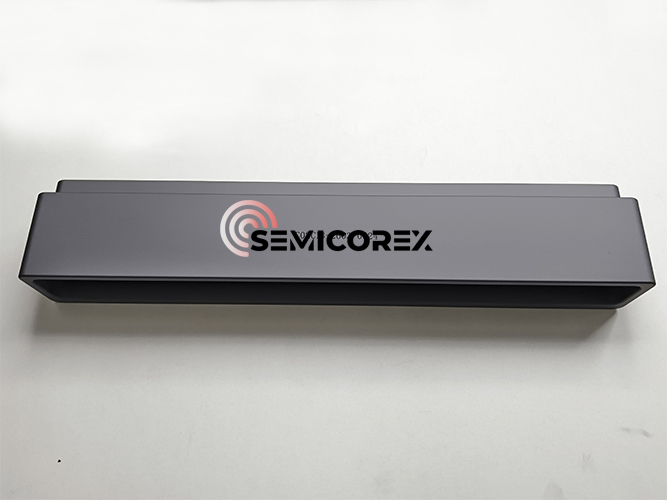
Bare graphite works fine until the moment it doesn’t. Under repeated thermal cycling, the edges of the graphite matrix start to oxidize and flake away, leaving pits that catch debris and accelerate wear. Operators often mistake this for “normal” surface aging, but it’s really a progressive loss of dimensional stability. Once those micro-cavities form, the part no longer holds a consistent contact face, and friction climbs quietly before a visible failure.
Another weak point shows up in high-humidity or mildly corrosive environments. Raw graphite absorbs moisture and reacts with certain gases, softening the binder and loosening the grain structure. The result is a dusty, crumbling surface that contaminates nearby components. SiC coating changes that dynamic by sealing the pores with a dense, chemically inert layer. It blocks oxygen and moisture from reaching the graphite underneath, so the core stays intact even when the outer surface sees aggressive media.
Perhaps the most practical fix SiC offers is at the wear interface. The hard, glassy silicon carbide shell takes the brunt of sliding contact, keeping the underlying graphite from shedding particles. It also spreads heat more evenly across the face, reducing hot spots that trigger localized oxidation. The graphite still provides the low-friction base and machinability, but the SiC skin handles what bare graphite was never designed to survive.
Comparing Thermal Shock Resistance: SiC Coated vs. Uncoated Graphite
Graphite's ability to survive rapid temperature swings has always been a double-edged sword. While the base material handles thermal gradients reasonably well due to its low expansion coefficient, repeated cycling in oxidizing environments gradually opens microcracks and erodes surface integrity. The moment a plasma or molten metal touches the surface, uncoated graphite begins to sacrifice itself—particles flake off, porosity widens, and the component loses dimensional accuracy far sooner than a static thermal test would suggest.
Applying a silicon carbide layer changes the failure sequence entirely. The coating's higher stiffness and different expansion rate create a constrained interface, but that constraint also redistributes stress away from crack-prone edges. In practice, SiC-coated graphite survives more cycles because the coating acts as a thermal shield during the first critical milliseconds of heating, reducing the peak temperature gradient inside the graphite bulk. Cracks that do form tend to stay within the coating rather than propagating into the substrate, which preserves the core's structural role.
The trade-off appears under extreme asymmetric heating. A thick SiC layer can spall if the temperature differential across the coating exceeds its own toughness, sometimes exposing bare graphite faster than no coating at all. For this reason, selection isn't simply coated versus uncoated—it hinges on matching coating thickness and deposition quality to the specific shock profile a component will face.
Where SiC Coated Graphite Components Outperform in Real Furnace Runs
Silicon carbide coated graphite components truly shine in high-temperature vacuum or inert atmosphere furnaces, where bare graphite would rapidly degrade. In semiconductor crystal growth, for example, the coating prevents carbon contamination of silicon melts while withstanding thermal shocks from cyclic heating. It also resists attack by aggressive process gases like hydrogen or ammonia that are common in MOCVD reactors, extending the service life of susceptors and wafer carriers well beyond uncoated graphite.
Another area where SiC-coated graphite stands out is in aluminum and zinc vapor deposition lines. The coating forms a dense, non-porous barrier that stops metal vapor infiltration, which typically causes internal oxidation and swelling in plain graphite parts. This translates to fewer furnace shutdowns, lower particle generation, and more consistent coating thickness on the final product—something operators notice immediately in reduced scrap rates.
Finally, in continuous pusher or roller hearth furnaces used for powder metallurgy sintering, SiC-coated graphite boats and trays handle the combined stress of mechanical abrasion and repeated exposure to reducing atmospheres. The hard ceramic surface resists wear from loading and unloading, while the graphite core maintains excellent thermal conductivity. This combination keeps the parts dimensionally stable over hundreds of cycles, making them a practical upgrade for lines that struggle with graphite dust or rapid component replacement.
Choosing the Right SiC Coating Thickness for Your Thermal Process
Getting the SiC coating thickness right starts with a clear look at your thermal cycle. Thinner coatings, often in the 8–15 µm range, respond faster to temperature changes and are less likely to crack under rapid heating or cooling. That makes them a solid pick for R&D chambers or processes that cycle often and don't push the equipment to extreme temperatures. The downside is reduced protection against aggressive gases or molten materials, so thin layers work best when the underlying graphite or carbon composite isn't heavily attacked.
If your process involves high temperatures above 1500 °C, corrosive halogens, or repeated exposure to reactive metals, a thicker coating—typically 25–50 µm or more—usually pays off. The extra SiC acts as a durable barrier and can extend the life of susceptors, crucibles, and heating elements. However, thickness also brings more stress at the interface. A very thick layer can spall or delaminate if the substrate expands and contracts differently, especially when the part has sharp corners or complex geometry.
The practical approach is to match the coating to the most demanding step in your process, not just the average condition. Work with your coating supplier to test a few thicknesses on a scrap part or a low-cost coupon. Look at edge coverage, surface roughness, and any signs of cracking after a few cycles. In many cases, a mid-range thickness around 20–30 µm offers a good balance between protection and thermal stress for semiconductor or high-temperature vacuum furnaces.
Long-Term Cost Benefits of SiC Coated Graphite in High-Heat Environments
Uncoated graphite components in furnaces or plasma chambers often degrade quickly due to oxidation and thermal stress. A silicon carbide coating changes the economic equation by sealing the surface against oxygen and reactive gases. This protection means parts retain dimensional stability far longer, so replacement cycles stretch from months to years in many high-heat operations.
The real savings show up in reduced downtime and labor. Every time a graphite susceptor or heating element fails, production stops for removal, inspection, and reinstallation. With SiC-coated graphite, those interruptions become rare. In semiconductor crystal growth, for example, a coated crucible can survive multiple process campaigns where an uncoated one would need swapping after each run. Multiply that by the cost per hour of lost output, and the coating pays for itself several times over.
Energy consumption also drifts downward because the coating maintains emissivity and surface cleanliness longer, preventing efficiency losses from pitting or ash buildup. Maintenance teams spend less time on preventive replacement and more on actual throughput. Over a five-year operating window, facilities using SiC-coated graphite report noticeably lower total cost of ownership compared with bare graphite, even after accounting for the initial coating premium.
FAQ
The silicon carbide layer acts as a dense, oxidation-resistant barrier while the graphite core retains its dimensional stability and thermal conductivity even when temperatures climb sharply. This combination helps prevent erosion and extends service life in furnaces and reactors.
Semiconductor manufacturing, solar wafer production, metallurgy, and advanced ceramics processing all use SiC coated graphite components. They are common in susceptors, crucibles, heating elements, and MOCVD equipment where clean, stable thermal performance matters.
Bare graphite begins to oxidize above roughly 400°C in air. The silicon carbide coating seals the surface and slows oxygen penetration significantly, allowing the component to hold up far longer under repeated thermal cycling without losing structural integrity.
Yes, when the coating and substrate are well matched, these components tolerate rapid thermal cycling. The graphite core absorbs thermal stress well, and the SiC layer remains intact if the part is not subjected to mechanical shock or extreme thermal gradients beyond its rating.
Look for uniform coating thickness, good adhesion to the graphite, a low porosity surface, and evidence of controlled thermal expansion matching. Reputable suppliers often provide micrographs or test data showing coating density and purity levels for demanding applications.
Complex shapes and large plates are possible, but very thin edges or sharp internal corners can create stress points where coating cracks may start. Most manufacturers can produce custom geometries as long as the design allows for even coating deposition and post-coating inspection.
Lifespan depends on operating temperature, atmosphere, thermal cycling frequency, and cleanliness of the process. In well-controlled environments, coated parts often outlast uncoated graphite by several times, though eventual coating wear or microscopic pinhole formation will require replacement.
Coating delamination, micro-cracks from mechanical damage, and localized oxidation through pinholes are the main issues. Preventive handling, avoiding sudden impacts, and regular visual inspection can catch early signs before failure affects the production batch.
Conclusion
Silicon carbide coatings fundamentally change how graphite survives in extreme thermal environments. Bare graphite starts to oxidize aggressively above 400°C, and beyond 2000°C the combination of oxygen, reactive gases, and rapid thermal cycling causes severe erosion, pitting, and structural weakening. A dense, adherent SiC layer seals the graphite surface, preventing oxygen from reaching the carbon substrate while also acting as a diffusion barrier against silicon vapor and metal fumes common in furnace atmospheres. The coating’s thermal expansion closely matches graphite, so it does not crack or spall under sudden temperature swings—unlike uncoated graphite, which often fails from thermal shock after just a few cycles. In side-by-side quench tests, SiC-coated components routinely withstand dozens of rapid heating and cooling events with minimal weight loss, whereas bare graphite shows visible surface degradation and microcracking after only a handful of shocks. This stability translates directly into longer service life for susceptors, crucibles, and heater elements.
Real furnace runs highlight the practical advantage. In silicon carbide crystal growth, coated graphite crucibles survive multiple process cycles without contaminating the melt, while uncoated versions shed particles that ruin ingot quality. Coating thickness matters: too thin (under 50 microns) and you risk pinhole defects; too thick (above 150 microns) can lead to internal stress and delamination during frequent thermal cycles. For most high-temperature processes, a carefully controlled 80–120 micron layer offers the best balance of protection and flexibility. Over months of continuous operation, the cost picture shifts decisively. SiC-coated graphite parts may cost 30–50% more upfront, but they last three to five times longer, reduce downtime for replacements, and cut the risk of catastrophic failure that damages other furnace components. When you factor in energy savings from stable thermal profiles and lower scrap rates, the coated option becomes the clear economic choice for any facility running above 1800°C.
Contact Us
Contact Person: Svenja Wei
Email: [email protected]
Tel/WhatsApp: +8613567891907
Website: https://www.semicorex.com