

Advanced Corrugated Rotary Die Making Equipment for Precision Die Cutting
2026-11-01
Precision die cutting on corrugated board isn't just about sharp blades—it's about repeatability at speed, zero waste, and tooling that holds tolerances shift after shift. Yet many converters still fight the same battles: edge fray, registration drift, and rotary dies that wear out before the job does. That's where ADEWO's advanced rotary die making equipment changes the equation.
Precision Beyond the Blueprint Inside Rotary Die Cutting Cells
In a rotary die cutting cell, the blueprint is only a starting point. The true measure of precision emerges when the tooling meets the material at full speed. Variables that never appear in CAD files—web tension flutter, micro-vibrations from the drive train, even the ambient humidity swelling a paper liner—force constant, subtle adjustments. Operators who have run the same job for years learn to read the sound of the anvil and the curl of the waste matrix, tweaking pressure knobs by fractions of a millimeter until the cut edge looks polished under a loupe.
Modern cells embed sensors that track cutting force, bearing temperature, and die deflection in real time, feeding corrections back to servo motors faster than any human hand. Yet this automation doesn't replace the need for tactile judgment. A slight change in adhesive softness or a new lot of film can shift the sweet spot for kiss-cutting pressure. The best setups pair closed-loop control with a machinist's intuition—someone who notices a faint chatter mark on the liner and knows to nudge the stripper angle before a full run of rejects piles up.
Material variability is the uninvited guest at every setup. Thickness drifts of a few microns across a roll, uneven silicone release, or static cling between layers all lie outside the tidy geometry of the drawing. Precision beyond the blueprint means building a process that absorbs these drifts without stopping. It's the difference between a die that cuts exactly to nominal dimensions and one that cuts consistently to nominal dimensions across ten thousand cycles, with no scrap spikes and no operator panic.
Why Flute Profile Integrity Depends on Kiss-Cutting Forces
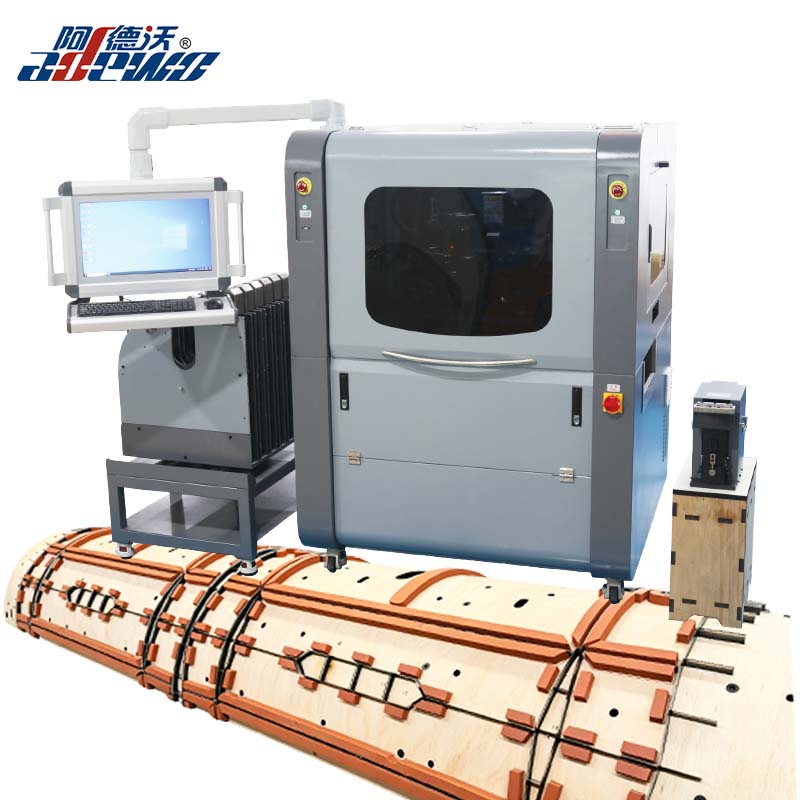
The structural performance of corrugated board hinges on maintaining a crisp, uniform flute profile. When a cutting or creasing tool kisses the surface, the force it applies travels through the facings and into the fluted medium. Anything more than a light touch begins to flatten the flute tips, reducing the board's effective caliper and compromising its cushioning ability. This is why kiss-cutting forces must be tuned to the exact thickness and flute type—A, B, C, E, or F—each responds differently to applied pressure.
Excessive kiss-cutting force creates permanent deformation in the flute geometry. The medium loses its arched shape near the cut line, and the board's edge crush resistance drops sharply. In contrast, a well-calibrated kiss cut leaves the flute profile intact, preserving the micro-arch structure that gives corrugated board its strength. Manufacturers often measure the residual flute height after cutting to verify that the force was neither too aggressive nor too weak.
Maintaining flute integrity through kiss-cutting also matters for downstream converting processes. If flutes are partially crushed during die-cutting, folding and gluing operations encounter inconsistent board thickness, leading to jams and misaligned joints. By holding kiss-cutting forces within a narrow tolerance, converters can avoid these issues and ensure the finished carton performs reliably in stacking and transport.
Servo-Driven Registration Fixes the Drift No One Talks About
Most registration errors on high-speed converting lines don’t start as obvious misalignment. They begin as a slow phase shift between the web and the die or print cylinder—barely a few hundredths of a millimeter per thousand cycles. By the time an operator spots the scrap, the drift has already been compounding for minutes. Servo-driven registration attacks that creep directly: the controller reads the actual position from the registration mark sensor, compares it to the commanded master axis, and applies a correction to the follower axis before the next repeat. That closed-loop trim happens continuously, not just at a single mark-per-revolution checkpoint.
What makes this drift tricky is that it rarely comes from one big mechanical fault. Slight tension changes as a roll builds or unwinds, thermal expansion in the frame after startup, even bearing wear that hasn’t yet become audible—all of these nudge the repeat length by tiny increments. A fixed gear train can’t compensate for that; it just repeats the same phase relationship while the real world moves around it. Servo registration treats the target position as a moving correction, recalculating offset from the last few marks and adjusting velocity or acceleration within the cycle. That means the system can hold registration through ramp-ups, splices, and long runs without waiting for the error to become visible.
The real payoff is what doesn’t happen on the floor: fewer manual adjustments, fewer rejected rolls after a speed change, and no more “chasing” the registration dial all shift. Operators stop reacting to drift and start trusting the line to hold its own phase. That’s the drift nobody talks about in spec sheets—because it only shows up after several thousand cycles, when the process has warmed up and the operator’s attention is somewhere else.
The Hidden Cost of Standard Steel Rule Dies in High-Volume Corrugated Runs
When a packaging plant pushes standard steel rule dies through tens of thousands of corrugated sheets, the purchase price of the tooling fades into background noise. The rule tips dull unevenly after repeated strikes against abrasive liners and recycled fiber. Operators compensate by cranking up platen pressure, which in turn crushes the corrugated medium, weakens box compression strength, and leaves ragged edges that require extra manual stripping. Each adjustment adds minutes to a process that was supposed to be automated.
There is also the quiet cost of inconsistent scoring. Standard steel rule has a wider tolerance range than high-performance alternatives, so as it wears, score lines drift outward by a fraction of a millimeter. On a single blank that means nothing. Multiplied across a million blanks, it means flaps that don't fold square, jammed folder-gluers, and a growing pile of rejected cartons that someone has to rework or scrap. The hidden expense is not the die itself but the labor, waste, and machine time spent chasing problems the die introduced.
Eventually the rule starts cracking at the bends or snapping at the joints, often midway through a shift. The line stops, the die is pulled, and a replacement is rushed in. If the backup die has not been properly prepared or if the same standard steel was used for it, the cycle repeats sooner than expected. In high-volume runs, the true cost of standard steel rule dies shows up in missed delivery windows, overtime wages, and the slow erosion of customer confidence when carton quality varies from batch to batch.
Modular Die Cassettes and the End of Hour-Long Changeovers
Traditional die changes eat up production time because every component has to be unbolted, realigned, and tested in the press. Modular die cassettes put the entire tooling set into a pre-assembled, self-contained unit that slides out as one piece. The operator doesn't touch individual dies; the whole cassette is swapped in a single motion.
On many lines, the shift is dramatic. A job that used to require a crane, alignment bars, and several trial strokes now comes down to releasing two locks, pulling the old cassette, pushing in the new one, and letting the press read the preset parameters. What once took forty-five minutes to an hour can be finished in under five minutes, with no guesswork about positioning.
Because cassettes are set up and adjusted offline, there's no need for fine-tuning at the press. That removes the usual back-and-forth of test hits and corrections, and it also makes short runs more practical. A shop can move from one part number to the next without losing half a shift to changeover.
Keeping Heavy Board from Crushing While Holding Tight Kerf Widths
A heavy board tends to sag or shift as the cut progresses, and that movement is what closes the kerf against the blade. Rather than fighting the weight with more forward pressure, place support near the exit side so the offcut can’t lever downward. Even a simple roller stand set level with the saw table will keep the slot open long enough for the blade to finish cleanly.
Tight kerf widths leave very little room for error, so any pinching quickly turns into burn marks or a stalled saw. Choose a blade with a thicker plate or stabilizer slots if you must cut dense, heavy stock. A splitter or riving knife matched to the kerf also stops the board from squeezing the blade after the cut, which is where most binding starts.
For repeated ripping, check that both infeed and outfeed supports stay dead level. A drop of even a quarter inch on the outfeed side lets the board’s own weight twist the cut line. If the kerf starts to close mid-cut, stop and insert a small wedge into the gap behind the blade, then resume with slower, steady feed instead of forcing the board through.
FAQ
The rigid frame and servo-driven feed rollers work together to keep board tension constant through the cut zone. That consistency, along with an automatic compensation system for board caliper variations, lets the machine hold registration within a few thousandths of an inch even on multi-wall sheets.
Instead of relying on a fixed pressure setting, the anvil and die cylinder gap adjusts in real time based on thickness feedback from laser sensors. This allows clean cuts across A, B, C, E, and F flutes without crushing the flutes or leaving partial fibers at the trim edges.
Weekly checks on bearing temperatures and daily inspection of the urethane anvil cover make the biggest difference. The automatic lubrication system handles most grease points, but operators should still wipe down the magnetic die cylinder surface after every shift to remove adhesive residue and paper dust that can throw off die seating.
Yes. The quick-change die chase and memory-based job settings reduce changeover to under ten minutes for most standard box styles. Operators can store exact impression, speed, and side-trim values from previous runs, so repeating a job only requires loading the die and selecting the stored recipe.
The use of a full-width magnetic cylinder with a milled register slot eliminates the need for clamping bolts that create uneven pressure. Dies seat firmly against the cylinder face, and the low-inertia design allows the cylinder to accelerate and decelerate without torsional flex that typically causes misregistration at high line speeds.
The guarding includes a light curtain across the feed opening and a two-hand control for manual jog mode. If the machine detects an unexpected load spike or an open guard during rotation, the drive system brakes the cylinders in under 200 milliseconds and dumps air pressure from the nip release circuit.
For standard corrugated board from 1.5 to 8 mm thick, the rotary line holds print-to-cut and cut-to-fold tolerances around ±0.15 mm at production speeds. Flatbed systems can match that on some materials, but they usually require slower cycle rates and more frequent die maintenance to stay within that window.
Conclusion
Modern rotary die cutting cells for corrugated board no longer treat the blueprint as the final word. The real work happens in how kiss-cutting forces are tuned to flute profile integrity: too much pressure collapses the medium, too little leaves hanging fibers and ragged edges. Servo-driven registration has quietly replaced mechanical stops because it corrects the micro-drift that occurs as board temperature, humidity, and tension shift through a long run. That drift, if ignored, turns a 0.5 mm print-to-cut mismatch into a stack of rejected retail displays. Equipment built around direct-drive servos and closed-loop feedback holds registration within a few thousandths of an inch without constant operator babysitting.
High-volume corrugated plants are also waking up to the hidden cost of standard steel rule dies. Rule teeth dull faster in recycled board, and every re-knife or replacement job eats into margin that a modular die cassette could preserve. Quick-change cassettes cut hour-long changeovers down to minutes, and they let a single machine jump between shipping boxes, point-of-purchase trays, and intricate die-cut toppers without losing production tempo. For heavy board, the latest rotary systems use variable pressure zones and progressive cutting geometry to prevent crushing near scores while still holding a tight kerf. That balance keeps walls crisp, stripping clean, and throughput high on board weights that would choke older fixed-gap machines.
Contact Us
Contact Person: KAELYN LEE
Email: [email protected]
Tel/WhatsApp: +86 15012673758
Website: https://www.china-adewo.com